Acidic Foods List: Acid-Forming Foods by Group (with PRAL)
Basentracker Team
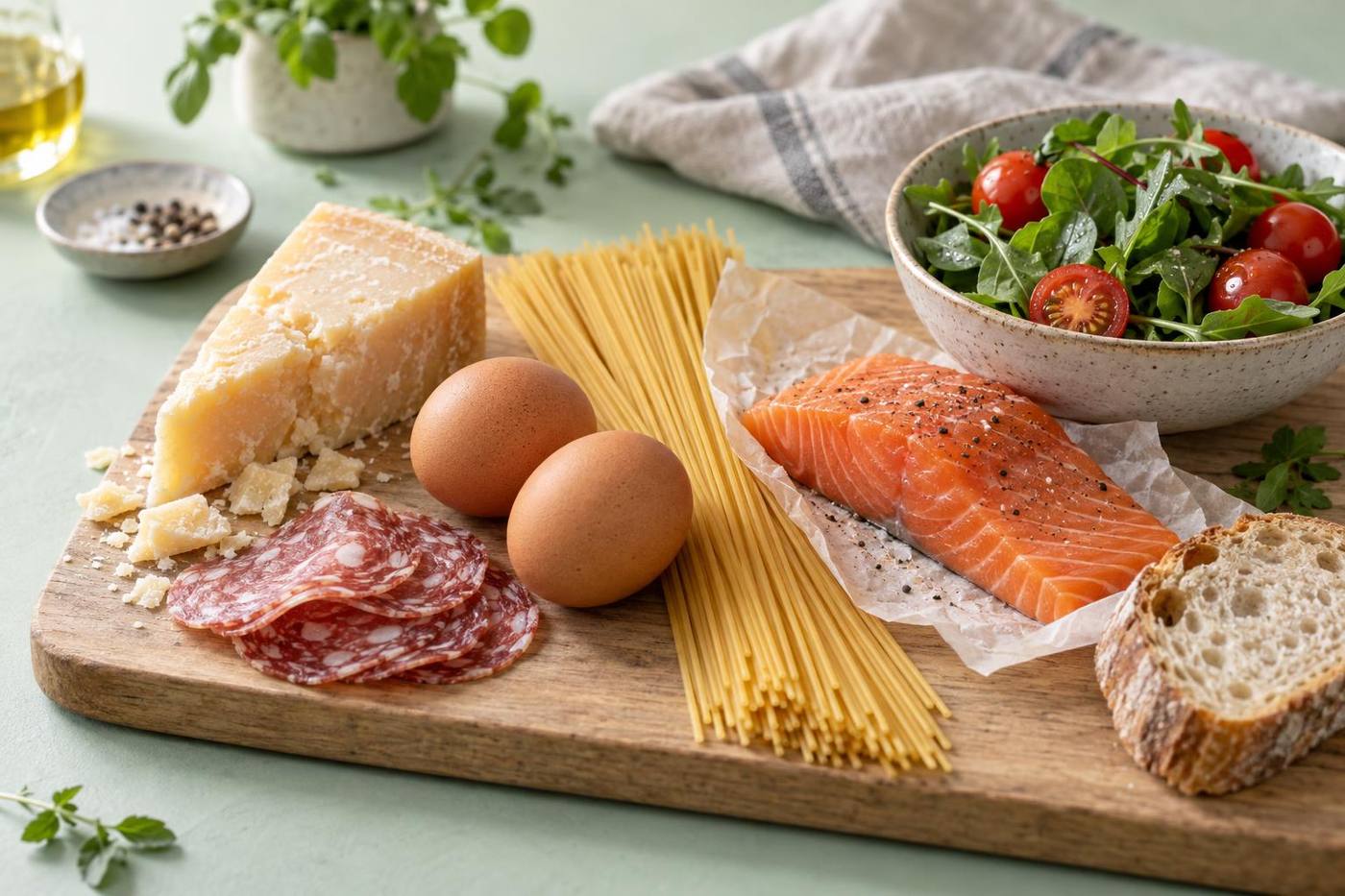
Acid-forming foods are mostly high in protein: cheese, meat, sausage, fish and eggs, plus grain products, nuts and seeds. The strongest are hard cheeses like Parmesan (+29.6 per 100 g), egg yolk (+24.6), meat and sausage (about +5 to +17) and fish (about +3 to +18). In the Basentracker database, every meat, every fish and every cheese is acid-forming, but not a single fruit. Foods that taste acidic, like lemon or vinegar, are alkaline-forming in the body. Acid-forming doesn’t mean unhealthy: fish, lentils, oats and nuts belong in a good diet. What matters is the serving and what you eat with it.
What “acidic” means here
“Acidic foods” can mean two different things. A food can taste sour because it has a low pH, like lemon juice or vinegar. Or it can be acid-forming: after digestion, it leaves an acid load that your kidneys have to excrete. This list is about the second meaning. For sour foods and their pH values, see the section Sour but alkaline-forming below.
The acid load is measured by the PRAL (Potential Renal Acid Load). Protein and phosphorus raise it: sulfur-containing amino acids turn into sulfuric acid, phosphorus into phosphoric acid. Potassium, magnesium and calcium lower it. A positive value means acid-forming, a negative value alkaline-forming.
The values in the tables are per 100 g. How much a food really counts only shows up in the serving. How your body handles the acid: Acid-base balance explained.
Acid-forming foods per serving
Per 100 g, Parmesan comes first. On your plate, the order looks different, because you eat 10 to 30 g of cheese but 150 to 250 g of quark or chicken.
| Food | Serving | PRAL per serving |
|---|---|---|
| Low-fat quark | one tub (250 g) | +23.4 |
| Chicken breast, cooked | 150 g | +19.8 |
| Roast beef | 150 g | +19.3 |
| Salmon, cooked | 150 g | +17.3 |
| Bratwurst | 150 g | +16.9 |
| Mozzarella | one ball (125 g) | +15.9 |
| Pasta, cooked | 250 g | +14.4 |
| Salami pizza | a whole pizza (350 g) | +14.3 |
| Eggs, boiled | two eggs (120 g) | +12.8 |
| Tofu | 150 g | +12.4 |
| Cooked ham | 50 g | +6.9 |
| Gruyère | one slice (30 g) | +6.2 |
| Pumpkin seeds | a handful (30 g) | +5.1 |
| Cheddar | one slice (30 g) | +5.1 |
| Lentils, cooked | 150 g | +4.6 |
| Salami | 30 g | +4.3 |
| Rolled oats | 50 g | +3.4 |
| Rice, cooked | 180 g | +3.2 |
| Parmesan | grated (10 g) | +3.0 |
PRAL values: Basentracker food database, converted to the amount shown.
Low-fat quark, a fresh cheese similar to strained yogurt, looks harmless at +9.4 per 100 g. But a whole tub brings more acid than a chicken breast. Parmesan, on the other hand, has the highest value per 100 g on the list and ends up last as a serving, because you only grate a little over your pasta.
The list by food group
All values per 100 g, sorted from the strongest to the weakest acid-former. You can find every food with a serving calculator in the alkaline food list.
Cheese
All 37 cheeses in the database are acid-forming. Hard cheese is highest because it packs a lot of protein and phosphorus into little water. Cream cheese and ricotta are much milder.
| Food | PRAL per 100 g |
|---|---|
| Parmesan | +29.6 |
| Emmental | +21.0 |
| Gruyère | +20.5 |
| Gouda, young | +17.5 |
| Cheddar | +16.9 |
| Camembert | +15.2 |
| Mozzarella | +12.7 |
| Feta | +11.1 |
| Cottage cheese | +8.8 |
| Ricotta | +3.4 |
| Cream cheese | +3.0 |
Single answer: Is cheese alkaline?
Meat and sausage
All 67 meats and sausages are acid-forming. Lean, cooked meat is especially high, because cooking removes water and concentrates the protein. Fatty sausages like frankfurters or mortadella contain less protein and therefore have lower values.
| Food | PRAL per 100 g |
|---|---|
| Beef jerky | +17.2 |
| Salami | +14.5 |
| Cooked ham | +13.8 |
| Pork chop, cooked | +13.7 |
| Chicken breast, cooked | +13.2 |
| Turkey breast, raw | +13.0 |
| Roast beef | +12.9 |
| Ground beef, cooked | +12.1 |
| Bratwurst | +11.3 |
| Liver sausage | +10.0 |
| Smoked ham | +8.2 |
| Frankfurters | +6.9 |
| Mortadella | +6.6 |
Single answers: Is meat alkaline?, Is chicken alkaline?
Fish and seafood
All 56 fish and seafood items are acid-forming, in a similar range to meat. Pollock is lowest at +3.1 raw and +4.2 cooked, canned sardines are highest at +18.2.
| Food | PRAL per 100 g |
|---|---|
| Sardines, canned | +18.2 |
| Tuna, cooked | +13.1 |
| Tuna, canned | +12.0 |
| Salmon, cooked | +11.5 |
| Smoked salmon | +11.2 |
| Shrimp, cooked | +11.1 |
| Mackerel, cooked | +10.6 |
| Trout, cooked | +10.1 |
| Herring, cooked | +9.5 |
| Cod, cooked | +8.7 |
| Pollock, cooked | +4.2 |
Single answer: Is salmon alkaline?
Eggs and dairy
In an egg, the acid is in the yolk (+24.6), while the white is +2.1. Dairy splits into two groups: quark and skyr are clearly acid-forming, milk, yogurt and kefir are practically neutral.
| Food | PRAL per 100 g |
|---|---|
| Egg yolk | +24.6 |
| Egg, boiled | +10.6 |
| Scrambled eggs | +9.9 |
| Low-fat quark | +9.4 |
| Quark, semi-fat | +8.9 |
| Skyr | +5.8 |
| Egg white | +2.1 |
| Yogurt, 1.5% fat | +0.8 |
| Yogurt, 3.5% fat | +0.5 |
| Kefir | +0.2 |
| Whole milk | +0.1 |
Single answers: Are eggs alkaline?, Is quark alkaline?, Is milk alkaline?
Grains, bread, pasta and rice
115 of 121 grain products are acid-forming, most of them only slightly. Dry products like flour, bran and uncooked pasta have high values. They absorb water during cooking, which is why cooked pasta is +5.8 instead of +10.9. Classic muesli is slightly alkaline at −1.6, because the dried fruit offsets the oats.
| Food | PRAL per 100 g |
|---|---|
| Oat bran | +17.1 |
| Wheat tortilla (wrap) | +10.0 |
| Rolled oats | +6.8 |
| Pasta, cooked | +5.8 |
| Wheat roll | +5.5 |
| Wholemeal rye bread | +5.3 |
| Wholemeal pasta, cooked | +4.2 |
| White toast bread | +3.9 |
| White bread | +3.7 |
| Cornflakes | +3.0 |
| Quinoa, cooked | +2.7 |
| Wholemeal bread | +2.6 |
| Couscous, cooked | +2.5 |
| Brown rice, cooked | +1.9 |
| White rice, cooked | +1.8 |
| Muesli, classic | −1.6 |
Single answers: Are oats alkaline?, Is bread alkaline?, Is rice alkaline?
Nuts and seeds
22 of 29 nuts and seeds are acid-forming, some of them as strongly as meat per 100 g. Because a serving weighs only 20 to 30 g, their effect on your day stays small. Hazelnuts are the exception and slightly alkaline.
| Food | PRAL per 100 g |
|---|---|
| Hemp seeds | +35.0 |
| Pumpkin seeds | +17.0 |
| Tahini | +12.3 |
| Sunflower seeds | +11.9 |
| Almonds | +10.5 |
| Cashews | +7.1 |
| Peanut butter | +6.8 |
| Chia seeds | +6.3 |
| Walnuts | +5.6 |
| Flaxseeds | +4.2 |
| Hazelnuts | −3.2 |
Single answers: Are nuts alkaline?, Are almonds alkaline?
Legumes, tofu and seitan
Plant protein is acid-forming too, and the more concentrated it is, the higher the value. Seitan and tofu are in the range of fish. Lentils and chickpeas are only slightly acid-forming, white beans and kidney beans almost neutral, because they bring a lot of potassium.
| Food | PRAL per 100 g |
|---|---|
| Seitan | +14.0 |
| Tofu, plain | +8.3 |
| Tempeh | +6.8 |
| Red lentils, cooked | +3.9 |
| Lentils, cooked | +3.1 |
| Chickpeas, cooked | +1.7 |
| Kidney beans, cooked | +0.7 |
| White beans, canned | +0.4 |
Single answers: Is tofu alkaline?, Are lentils alkaline?, Are chickpeas alkaline?
Baked goods, snacks and ready meals
Here flour, eggs, milk, cheese and meat add up. Anything with cheese or breading is high, and a margherita pizza is much lower than a four-cheese pizza.
| Food | PRAL per 100 g |
|---|---|
| Ladyfingers | +12.8 |
| Schnitzel, breaded | +10.8 |
| Four-cheese pizza | +9.7 |
| Protein bar | +8.7 |
| Pound cake | +8.1 |
| Chicken nuggets | +8.0 |
| Fish sticks | +5.8 |
| Salami pizza | +4.1 |
| Croissant | +3.4 |
| Margherita pizza | +2.8 |
What isn’t acid-forming: fruit, vegetables and drinks
Not one of the 80 fruits in the database is acid-forming. Among vegetables, it’s 10 out of 110, mostly sprouts, plus canned mushrooms, artichokes and sugar snap peas, almost all only slightly. The strongest alkaline-formers are in our rankings of the most alkaline vegetables and the most alkaline fruits.
No drink is acid-forming to any real degree: cola is +0.5, beer −0.4, red wine −1.6 and black coffee −2.3. That cola and alcohol barely register on the PRAL doesn’t make them healthy: Alkaline diet myths.
Sour but alkaline-forming
Whether a food tastes sour is shown by the pH of the food itself. Lemon juice has a pH of 2 to 2.6. In your body, the fruit acid is broken down into carbon dioxide and water, leaving potassium and magnesium behind. That’s why everything in this table is alkaline-forming by PRAL.
| Food | pH | PRAL per 100 g |
|---|---|---|
| Lemon juice | 2.00–2.60 | −2.3 |
| Lime | 2.00–2.80 | −2.5 |
| Grapefruit | 3.00–3.75 | −2.6 |
| Strawberries | 3.00–3.90 | −3.0 |
| Apple cider vinegar | 3.10 | −2.0 |
| Rhubarb | 3.10–3.40 | −6.8 |
| Pineapple | 3.20–4.00 | −2.6 |
| Sauerkraut | 3.30–3.60 | −3.4 |
| Apple | 3.30–4.00 | −1.9 |
| Orange | 3.69–4.34 | −2.8 |
| Tomato | 4.30–4.90 | −4.2 |
pH values: “pH Values of Common Foods and Ingredients”, Clemson Cooperative Extension. PRAL values: Basentracker food database.
ℹ️ With acid reflux, pH is what counts
For your kidneys, lemon is alkaline. On its way down your esophagus, it is still acidic and can further irritate an already irritated lining. If you’re looking for foods high in acid because of heartburn or reflux, the PRAL won’t tell you what you tolerate. More: Acid reflux diet.
Single answers: Is lemon alkaline?, Is apple cider vinegar alkaline?, Are tomatoes alkaline?
Acid-forming doesn’t mean unhealthy
Many foods on this list belong in a balanced diet. Fish provides omega-3 fatty acids, saltwater fish also iodine. Legumes and oats provide fiber, nuts healthy fats, quark and eggs high-quality protein. If you cut them to improve your balance, you lose more than you gain.
On the other hand, not everything alkaline is healthy: potato chips are −17.0. The PRAL describes the acid load, not the quality of a food. How to eat enough protein without your day turning acidic: High-protein diet and PRAL.
How to balance acid-forming foods
The rule of thumb: every acid-forming serving needs a larger serving of vegetables, potatoes or fruit next to it. Three examples from the database.
Fish with potatoes and spinach. A salmon fillet on its own is +17.3. With boiled potatoes and spinach, the meal becomes clearly alkaline:
Salmon with potatoes and spinach
Pasta with a vegetable sauce instead of just cheese. 250 g of spaghetti with 20 g of Parmesan comes to +20.3. With a little less pasta, a tomato and spinach sauce and only 10 g of Parmesan, the balance flips:
Spaghetti with tomato and spinach sauce
- Spaghetti · 200 g +11.5
- Tomatoes, strained (passata) · 200 g −8.0
- Spinach · 150 g −19.4
- Parmesan cheese · 10 g +3.0
Bread with vegetables instead of cheese and ham. Two slices of wholemeal bread with Gouda and cooked ham add up to +12.0. Swap the ham for tomato, cucumber and bell pepper, keep the cheese, and the balance turns alkaline:
Wholemeal bread with Gouda and raw veggies
- Wholemeal bread · 100 g +2.6
- Gouda (young) · 30 g +5.3
- Tomato · 100 g −4.2
- Cucumber · 100 g −3.3
- Red bell pepper · 100 g −3.5
Which acid-formers are worth cutting back first, and the most common questions about rice, eggs, bread and coffee: What not to eat on an alkaline diet.
Keep reading: Alkaline foods chart with PRAL values, What to eat on an alkaline diet, Acidic body symptoms, PRAL calculator for your own meals.
Frequently Asked Questions
Which foods are the most acid-forming?
Per 100 g: hard cheeses like Parmesan (+29.6) and Emmental (+21.0), egg yolk (+24.6), canned sardines (+18.2), sausage like salami (+14.5) and cooked meat like chicken breast (+13.2). Per serving, meat, fish and a tub of low-fat quark come first, because you eat 150 to 250 g of them.
Is fruit acid-forming?
No. Not one of the 80 fruits in the Basentracker database is acid-forming. Even sour fruit like lemon (−4.0), grapefruit (−2.6) or red currants (−5.3) is alkaline-forming in the body.
Which vegetables are acid-forming?
Hardly any. Only 10 of 110 vegetable entries are slightly acid-forming, mostly sprouts, plus canned mushrooms (+2.5), artichokes (+0.8) and sugar snap peas (+0.8). One exception is spirulina powder at +15.4, but you only take a few grams of it.
Are acidic foods like lemons and tomatoes acid-forming?
No. Lemons, limes, tomatoes, vinegar and sauerkraut have a low pH and taste sour, but your body breaks down the fruit acids. What remains is potassium and magnesium, so their PRAL is negative: lemon −4.0, tomato −4.2, sauerkraut −3.4.
Is fish acid-forming?
Yes, all 56 fish and seafood items in the database. Values range from +3.1 (pollock, raw) to +18.2 (canned sardines), similar to meat. Fish is still a good choice because of its omega-3 fatty acids and, for saltwater fish, iodine. With potatoes and vegetables, the meal is alkaline.
Is pasta acid-forming?
Yes, slightly. Cooked pasta is +5.8 per 100 g, wholemeal pasta +4.2. A large serving of 250 g comes to +14.4. With a vegetable sauce of tomatoes and spinach, the dish becomes alkaline.
Which drinks are acid-forming?
Practically none. Cola is +0.5 per 100 ml, milk +0.1, spirits just above zero. Coffee (−2.3), wine (−1.6) and beer (−0.4) are slightly alkaline, water and tea just below zero.
Are acid-forming foods unhealthy?
Not automatically. Fish, legumes, oats, nuts and quark are acid-forming and still valuable. The goal isn't to cut them, but to balance them: every acid-forming serving needs a larger serving of vegetables, potatoes or fruit.
Sources: PRAL values and counts per group: Basentracker food database, as of October 2026, calculated according to Remer and Manz (see Sources). pH values: “pH Values of Common Foods and Ingredients”, Clemson Cooperative Extension.
How acidic was your day?
Basentracker calculates the PRAL of every meal with your real amounts. So you can see whether your cheese, meat and bread are balanced by enough vegetables.
Free for Android · iPhone coming soon
Conclusion
Acid-forming foods are cheese, meat, sausage, fish and eggs, plus almost all grain products and most nuts. Fruit never is, vegetables hardly ever, and foods that taste sour are usually alkaline-forming. Look at the serving instead of the value per 100 g: a tub of quark brings more acid than a serving of Parmesan. And balance instead of cutting out: with potatoes, vegetables and fruit next to them, even a day with fish, bread and cheese stays alkaline.