The 10 Most Alkaline Fruits: PRAL Ranking (2025)
Basentracker Team
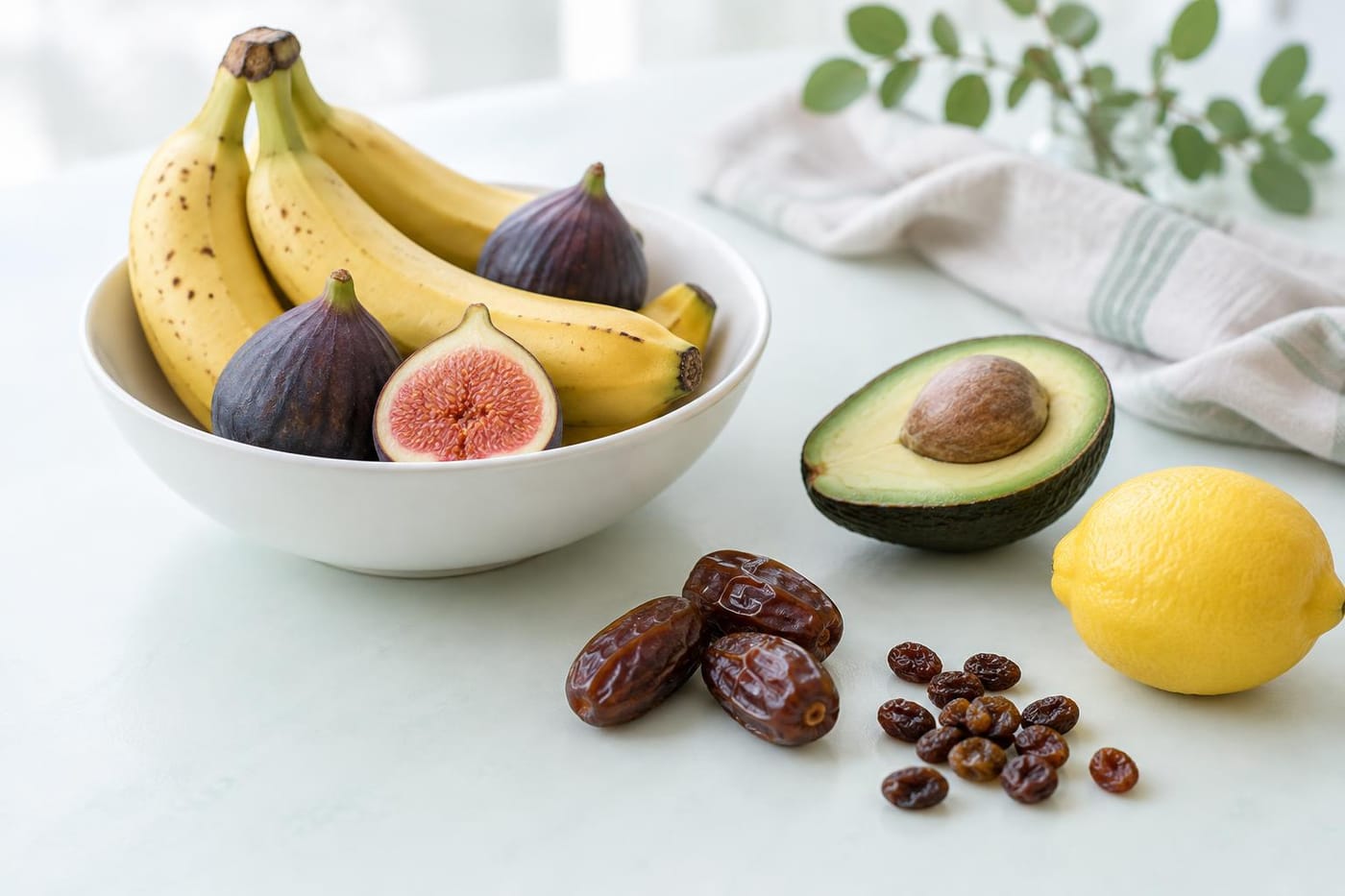
Based on PRAL, the most alkaline fruits are avocado, dates, apricots, bananas, black currants, red currants, guava, kiwifruit, passion fruit and figs. All of them have a negative PRAL, which means they are alkalizing in the body. Avocado leads the ranking with a PRAL of −9.9.
Fruit and the alkaline diet: what’s behind it?
Fruit has a reputation that sometimes puts it in a gray zone on the alkaline diet. Too much fructose, too much acid, too much sugar, people say. Yet almost every fruit is alkalizing in the body, no matter how sour it tastes. The key difference is not the taste but the PRAL, meaning the minerals left over after your body has metabolized the food.
Lemon tastes very sour, but it has a PRAL of −4.0 and is alkalizing. Meat tastes neutral, but it has a strongly positive PRAL and is acid-forming. This ranking shows which fruits have the strongest alkalizing effect, sorted by exact values from the Basentracker database.
This ranking only includes fruits you can find in German supermarkets or at farmers’ markets. Familiar classics like apples, strawberries, mangoes and raspberries follow in a section further down, with their exact PRAL values.
ℹ️ PRAL explained
We explain in detail what PRAL means and how it is calculated here: Alkaline foods: the complete list with PRAL values
The ranking: the 10 most alkaline fruits
The order is based on the exact PRAL values from the Basentracker database. All values refer to 100 g of the fruit in the form listed.
Avocado (ripe)
PRAL −9.9Botanically, avocado is a fruit. It leads the fruit ranking with a PRAL of −9.9, and it is easy to buy in everyday shopping in Germany. Its high potassium content and comparatively low phosphorus content produce the strongly negative PRAL. It also provides valuable unsaturated fatty acids, keeps you full and works in both sweet and savory dishes.
Everyday tip: Put avocado on your menu every day, as a spread, in a salad, as a side or on its own with a little lemon juice and salt. It is one of the most accessible ways to clearly improve your daily balance.
Date (fresh)
PRAL −7.8Fresh dates come in second with a PRAL of −7.8. The reason is their high potassium content combined with low phosphorus. Interesting: dried dates, the kind you usually find at the supermarket, even reach a PRAL of −13.4, because drying strongly concentrates the nutrients.
Everyday tip: Have two or three dates as a snack between meals, or use them as a natural sweetener in smoothies and porridge. Filling, alkaline and no effort at all.
Apricot (fresh)
PRAL −7.2Apricots are the most alkaline stone fruit in this ranking, and with a PRAL of −7.2 they even come ahead of bananas. The deciding factor is their high potassium content with very little protein and phosphorus. The season for fresh apricots is short, running from early summer into August. Dried apricots reach a PRAL of −21.8 and are available year-round.
Everyday tip: Cut fresh apricots in half and eat them as they are, or slice them into your yogurt. Out of season, small amounts of dried apricots are the alkaline alternative.
Banana (ripe)
PRAL −6.4The banana is the best-known alkaline fruit in everyday life, and with a PRAL of −6.4 it is rightly a staple of the alkaline diet. Its very high potassium content is the main reason for the strongly negative PRAL. Important: ripe bananas with a yellow, slightly spotted peel are more alkaline than unripe green ones, because their nutrient composition changes as they ripen. They also keep you full and provide quickly available energy.
Everyday tip: Use bananas as a breakfast ingredient or smoothie base, always ripe, never green. It is one of the easiest ways to bring your daily PRAL into negative territory fast.
Black currant (fresh)
PRAL −5.5Black currants are slightly more alkaline than their red sibling (PRAL −5.3), and with a PRAL of −5.5 they are the strongest native berry in this ranking. They also have the highest vitamin C content of all native berries. You can get them fresh in summer and frozen in any supermarket the rest of the year.
Everyday tip: Use frozen black currants year-round in smoothies or on your porridge. An underrated alkaline all-rounder grown close to home.
Red currant (fresh)
PRAL −5.3Red currants are barely behind their black sibling: PRAL −5.3, tart in taste and still clearly alkaline. They are a typical garden berry, available fresh in midsummer and frozen the rest of the year. With 3.5 g of fiber per 100 g, they provide more of it than apples or bananas.
Everyday tip: Add frozen red currants to your smoothie or sprinkle fresh ones over your muesli. Their tartness adds freshness to any fruit salad.
Guava (fresh)
PRAL −5.1Guava is an everyday fruit in Southern Europe and the tropics, and with a PRAL of −5.1 it is clearly alkaline. It is now easy to find in German supermarkets, especially in the warmer months. It is rich in vitamin C, potassium and fiber. The flavor is tropical and sweet with a slightly floral note. You can tell a ripe guava by its scent and by the way it gives slightly when you press it.
Everyday tip: Eat guava whole, skin and all. The skin is especially rich in nutrients. Or slice it and add a little lime juice for a refreshing snack.
Kiwifruit (fresh)
PRAL −4.9Kiwifruit is in the supermarket all year, and with a PRAL of −4.9 it is more alkaline than its tart taste suggests. With 71 mg of vitamin C per 100 g, it is one of the richest sources of vitamin C among the fruits you can buy, plus 3.9 g of fiber. In fall and winter, when native berries are out of season, it is one of the easiest alkaline fruits to get.
Everyday tip: Cut kiwifruit in half and scoop it out with a spoon, as a snack or for breakfast. It is ripe when it gives under light pressure.
Passion fruit (fresh)
PRAL −4.7Passion fruit is available year-round in German supermarkets, and with a PRAL of −4.7 it is a strong alkaline option. Its flavor is intensely fruity and tropically sour, yet it is still alkalizing in the body. Ripe passion fruits are slightly wrinkled. That is not a sign of poor quality but a sign of ripeness.
Everyday tip: Cut the passion fruit in half and scoop out the pulp with a spoon. Spoon it over yogurt, add it to smoothies or use it as a breakfast topping. Intense in flavor and alkalizing in effect.
Fig (fresh)
PRAL −4.7Fresh figs are available in almost every supermarket in late summer and fall, and they round out the ranking with a PRAL of −4.7. They are rich in potassium, calcium and fiber. By the way, dried figs are even more alkaline at a PRAL of −17.8, because drying strongly concentrates the nutrients.
Everyday tip: Cut fresh figs in half and eat them as they are, or pair them with arugula in a salad. Dried figs are one of the most alkaline snack options there is, all year round.
All 10 at a glance
| Rank | Fruit | PRAL per 100 g |
|---|---|---|
| 1 | Avocado (ripe) | −9.9 |
| 2 | Date (fresh) | −7.8 |
| 3 | Apricot (fresh) | −7.2 |
| 4 | Banana (ripe) | −6.4 |
| 5 | Black currant (fresh) | −5.5 |
| 6 | Red currant (fresh) | −5.3 |
| 7 | Guava (fresh) | −5.1 |
| 8 | Kiwifruit (fresh) | −4.9 |
| 9 | Passion fruit (fresh) | −4.7 |
| 10 | Fig (fresh) | −4.7 |
Note: PRAL is given per 100 g of food. The more of a fruit you eat, the bigger the effect on your daily balance.
How can you combine these fruits day to day?
The most alkaline morning smoothie
A ripe banana (PRAL −6.4) as a creamy base, plus frozen black currants (PRAL −5.5), one dried date (PRAL −13.4) for natural sweetness and a little water. Ready in three minutes, and your daily balance is immediately well into negative territory.
The alkaline snack
Avocado (PRAL −9.9) on wholemeal bread, with two or three dried dates (PRAL −13.4) as a sweet finish. The wholemeal bread is acid-forming, but the avocado and dates together more than offset it. A filling, alkaline meal in under five minutes.
The alkaline dessert
Sliced kiwifruit with fresh or frozen black currants. Both are in the ranking, both are strongly alkaline, and together they make an effortless dessert. In fall and winter, when fresh berries are hard to find, it is one of the best options.
What about apples, strawberries, mangoes and the like?
These classics of the German fruit bowl don’t make the top 10 because other fruits have stronger PRAL values. But every one of them is alkaline and worth eating every day:
| Fruit | PRAL |
|---|---|
| Papaya (fresh) | −4.5 |
| Honeydew melon (fresh) | −4.4 |
| Elderberry (fresh) | −4.1 |
| Lemon (fresh) | −4.0 |
| Pomegranate (fresh) | −3.8 |
| Sweet cherry (fresh) | −3.7 |
| Red grapes (fresh) | −3.5 |
| Peach (fresh) | −3.4 |
| Mango (ripe) | −3.3 |
| Strawberry (fresh) | −3.0 |
| Persimmon (fresh) | −3.0 |
| Orange (fresh) | −2.8 |
| Raspberry (fresh) | −2.7 |
| Pineapple (fresh) | −2.6 |
| Grapefruit (fresh) | −2.6 |
| Blackberry (fresh) | −2.4 |
| Mandarin (fresh) | −2.3 |
| Pear (fresh) | −2.3 |
| Apple (fresh) | −1.9 |
| Blueberry (fresh) | −1.3 |
All of these fruits are alkaline, and you can eat them every day without concern.
Which foods generally fit an alkaline diet: What can you eat on an alkaline diet?
What to cut back on: What should you avoid on an alkaline diet?
Basentracker does the math for you
Now you know which fruit is the most alkaline. But how many dates or bananas do you need to keep your day truly alkaline?
Your daily balance at a glance: every day, automatic, no math.
You enter your meals, the app calculates the PRAL automatically and shows you your daily value. How strong is each fruit's effect? Basentracker does the math for you, for every bite.
Free for Android · iPhone coming soon
The bottom line: even an ordinary fruit bowl is alkaline
Avocado, dates, apricots and bananas lead the ranking of everyday fruits. If you prefer to eat with the seasons, currants, figs and kiwifruit are strong alkaline options depending on the time of year. And if you stick with apples and strawberries, you’re on the right side too: every fruit on this list has a negative PRAL and improves your daily balance.
Fruit is not the enemy of an alkaline diet. It is one of its most reliable allies.