What to Eat on an Alkaline Diet: The Complete Guide (2025)
Basentracker Team
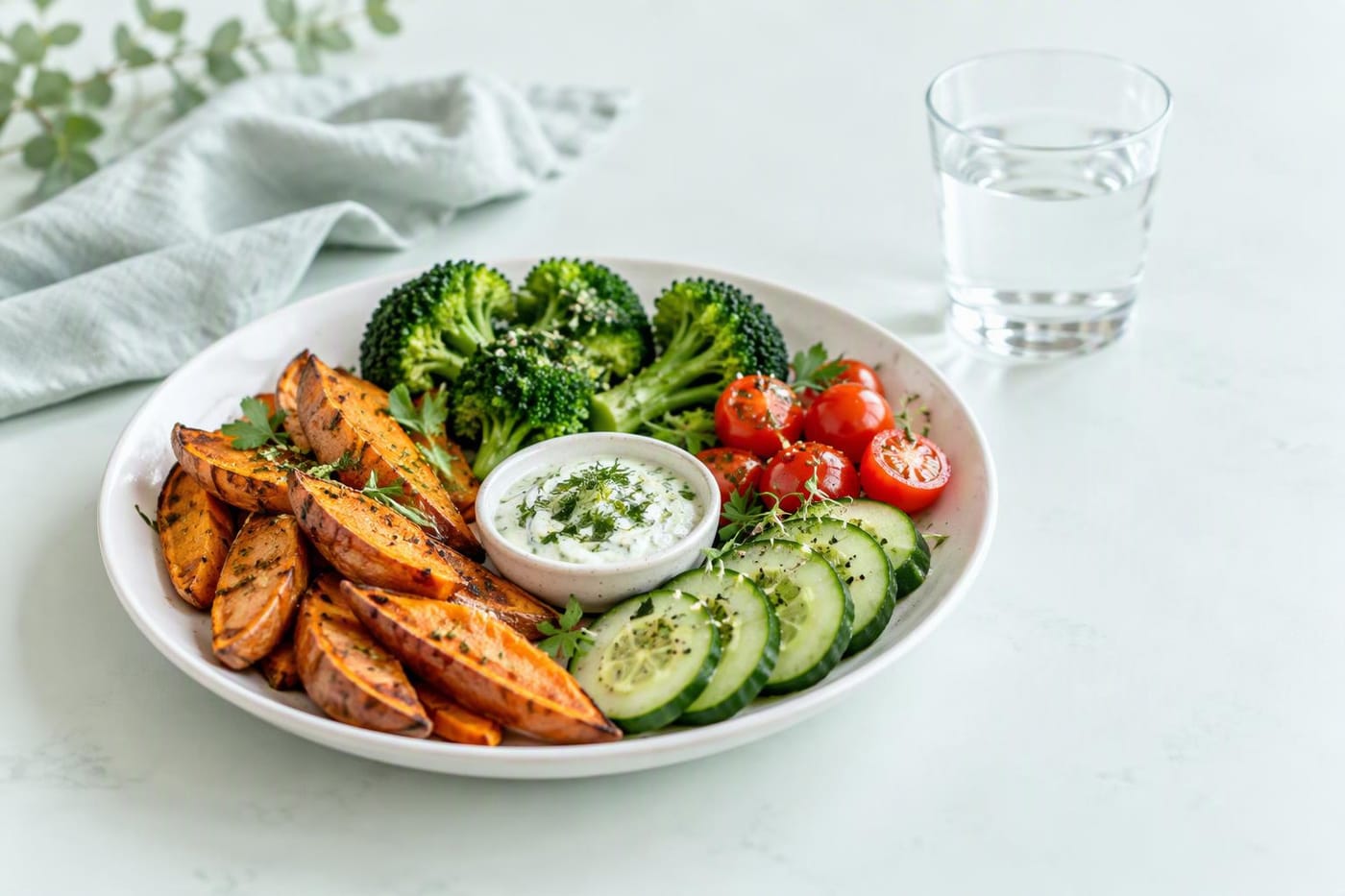
On an alkaline diet, you mainly eat fresh vegetables, fruit, herbs, legumes and nuts. Vegetables, fruit and herbs have a negative PRAL and have an alkalizing effect in the body. Legumes are close to zero, and nuts are mixed. Meat, cold cuts, dairy products and white flour products are acid-forming. You should cut back on them, but you don’t need to cut them out completely. The rule of thumb: 70% alkaline, 30% acid-forming.
What does “eating alkaline” actually mean?
You’ve heard about the alkaline diet. Maybe from a friend, from your doctor or on a podcast. But what is really behind it?
Your body regulates the pH of your blood very precisely. What you eat affects how much work it has to do to get there. Some foods leave behind an acid residue after they are metabolized, others an alkaline one. You can measure this with the PRAL (potential renal acid load), a scientific formula that shows how strongly a food affects your acid-base balance.
A negative PRAL means alkalizing. A positive PRAL means acid-forming. That’s really the core of it.
Eating alkaline doesn’t mean turning your life upside down or giving up on enjoying your food. It means giving your body more of what makes its job easier. And you can do that with completely normal foods from any grocery store.
📖 How the PRAL is calculated and where foods fall on the scale is explained in detail in our article: Alkaline foods: the complete list with PRAL values.
Which foods can you eat on an alkaline diet?
This is the real question. And the answer is better news than many people fear. The range of alkalizing foods is large, colorful and anything but boring.
Vegetables: the foundation
Vegetables are the most important group on an alkaline diet. Almost everything in the produce section has a negative PRAL. Here are a few examples from the actual database:
| Food | PRAL |
|---|---|
| Spinach (fresh) | −12.2 |
| Arugula (fresh) | −7.1 |
| Carrot (fresh) | −6.3 |
| Broccoli (fresh) | −6.1 |
| Celery stalk (fresh) | −5.2 |
| Tomato (fresh) | −4.2 |
| Zucchini (fresh) | −4.1 |
| Red bell pepper (fresh) | −3.5 |
| Cucumber (fresh) | −3.3 |
Eat them every day and plenty of them: raw, steamed, sautéed or as soup. The way you prepare them changes the PRAL, and for broccoli, boiling changes it a lot. But vegetables are still vegetables: alkaline.
Fruit: more than just a snack
Fruit is also mostly alkalizing. One of the most common misconceptions: a lemon tastes sour, so it must be acidic. Not true. In the body, it has an alkalizing effect (PRAL −4.0). Here are a few values:
| Food | PRAL |
|---|---|
| Avocado (ripe) | −9.9 |
| Apricot (fresh) | −7.2 |
| Banana (ripe) | −6.4 |
| Fig (fresh) | −4.7 |
| Strawberry (fresh) | −3.0 |
| Raspberry (fresh) | −2.7 |
| Apple (fresh) | −1.9 |
For breakfast, as a snack or for dessert, fruit always works.
Herbs and spices: small but powerful
What many people underestimate: herbs and spices are often extremely alkalizing. Fresh ginger root has a PRAL of −6.7, and turmeric powder even −35.5. If you regularly add fresh herbs or spices to your meals, you noticeably push your daily value into the alkaline range.
Basil, parsley, cilantro, ginger, turmeric, mint: all of them are more than welcome.
Legumes: almost neutral and filling
Lentils, chickpeas and white beans are sometimes viewed critically, yet they are an important part of an alkaline diet. Depending on how they are prepared, their PRAL is slightly positive or negative. But as part of a vegetable-rich meal, they tip the overall balance toward alkaline.
| Food | PRAL |
|---|---|
| White beans (boiled) | −1.2 |
| Kidney beans (boiled) | +0.7 |
| Chickpeas (boiled) | +1.7 |
| Lentils (boiled) | +3.1 |
As a meat substitute in curries, soups, salads or spreads, they are one of the best choices you can make for your acid-base balance.
Nuts and seeds: good companions
Almonds and flaxseeds show up in many alkaline diet guides. A look at the numbers shows: raw almonds have a PRAL of +10.5, which makes them clearly acid-forming. They are still valuable companions, because they are filling and provide healthy fats. A handful of 20 to 30 g (+2 to +3) hardly matters in the context of your whole day.
Unsweetened almond milk, on the other hand, is slightly alkaline at a PRAL of −1.3 and a good alternative to cow’s milk.
Water and herbal teas
Still water and unsweetened herbal teas support your acid-base balance and help your body excrete acids. By the way, coffee is more neutral than its reputation: black coffee has a PRAL of −2.3, which makes it slightly alkalizing.
What should you cut back on, and why don’t you need to ban anything?
Here’s the part that reassures a lot of people: there are no forbidden foods. There is only a new balance.
Acid-forming foods include meat, cold cuts, cheese, eggs and white bread. They have a positive PRAL and put more strain on your acid-base balance than vegetables and fruit. Sugar, alcohol and cola are around zero by PRAL, but for other reasons they only make sense in moderation.
But, and this is the key point: if you make 70% of your meals alkaline, you can enjoy the rest without a guilty conscience. Your body is not a system that collapses over one slice of bread or one glass of wine. What matters is the trend over the day, not perfection at every single meal.
💡 Tip
Want to keep your morning latte macchiato? No problem. Just add a green smoothie at breakfast and your balance is back on track.
What does an alkaline day look like in practice?
This is the practical part. No cookbook, no unrealistic meal plan, just real everyday scenarios.
🌅 Breakfast
A green smoothie with spinach (PRAL −12.2), banana (PRAL −6.4), ginger (PRAL −6.7) and lemon juice (PRAL −2.3). The balance of this breakfast is strongly alkaline. Or try rolled oats with berries and almonds. Rolled oats are slightly acid-forming (PRAL +6.8), but combined with berries, and across the whole day, everything stays well balanced.
🥗 Lunch
A big salad with arugula (PRAL −7.1), avocado (PRAL −9.9), red bell pepper (PRAL −3.5) and a lemon dressing. Or a vegetable curry with white beans (PRAL −1.2). Both are clearly alkaline. If you eat in a cafeteria, just go for vegetable sides and use less sauce.
🍎 Snack
A handful of strawberries and a few almonds. Or carrots with hummus: carrots (PRAL −6.3) plus a small amount of chickpeas, alkaline overall.
🍽️ Dinner
A baked sweet potato (PRAL −5.3) with steamed broccoli (PRAL −1.3) and fresh herbs. If you want meat, add a small piece of chicken. The rest of the day was alkaline enough, so it balances out.
Not one of these days calls for special ingredients from a health food store. You can find all of it at a regular grocery store.
Frequently asked questions
Can you drink coffee on an alkaline diet?
Yes. Black coffee has a PRAL of −2.3, so it is slightly alkalizing. One to two cups a day are no problem as long as the rest of your day leans alkaline in a balanced way. Espresso is also in the alkaline range at a PRAL of −1.9. Only if you drink your coffee with a lot of milk and sugar should you factor that into your overall balance.
Can you lose weight on an alkaline diet?
The alkaline diet is not a classic weight-loss diet, but many people lose weight on it. That’s because they automatically eat more fresh vegetables, fewer processed foods and less sugar. If your plate has more spinach salad and less white bread, you usually take in fewer calories too, without actively counting.
Is an alkaline diet suitable for vegetarians and vegans?
Very much so. In fact, it comes naturally. A plant-based diet is automatically mostly alkaline, because vegetables, fruit, legumes and herbs dominate the menu. If you already eat little meat and cheese, you are often close to an alkaline surplus without knowing it.
How long does it take to notice the first effects?
That varies from person to person. Many people report more energy, less bloating and better sleep after two to four weeks. If you used to eat a lot of meat, cheese and processed foods, you will usually notice the difference sooner. Important: the goal is not to hit perfect numbers right away, but to shift the trend over the long term.
Do you actually know whether your day was alkaline?
Now you know what goes on your plate. But in the evening, the question often comes up anyway: Was today good enough? Did I eat more alkaline than acid-forming food, or the other way around?
Do you know whether your day was really alkaline?
Now you know what goes on your plate. But in the evening, the question often comes up anyway: Did I eat more alkaline than acid-forming food? Basentracker calculates your PRAL automatically. You enter what you ate, the app adds up all the values and shows you at the end of the day where you stand. No math, no guessing, no table chaos. More than 950 foods are already in the database, all calculated with the same scientific formula.
Free for Android · iPhone coming soon
Bottom line: eating alkaline is not about giving things up
If you start bringing more spinach, broccoli, berries and herbal tea into your daily routine while cutting back a little on meat and white flour, you are already well into an alkaline diet. You don’t need a special diet, a cookbook or long lists of forbidden foods.
The trend over the day is what counts, not perfection at every single meal. And if you’d like some support and enjoy seeing a clear number in the evening, you now have a tool for that.