Alkaline Diet Myths: Why Alkaline Doesn't Mean Healthy
Basentracker Team
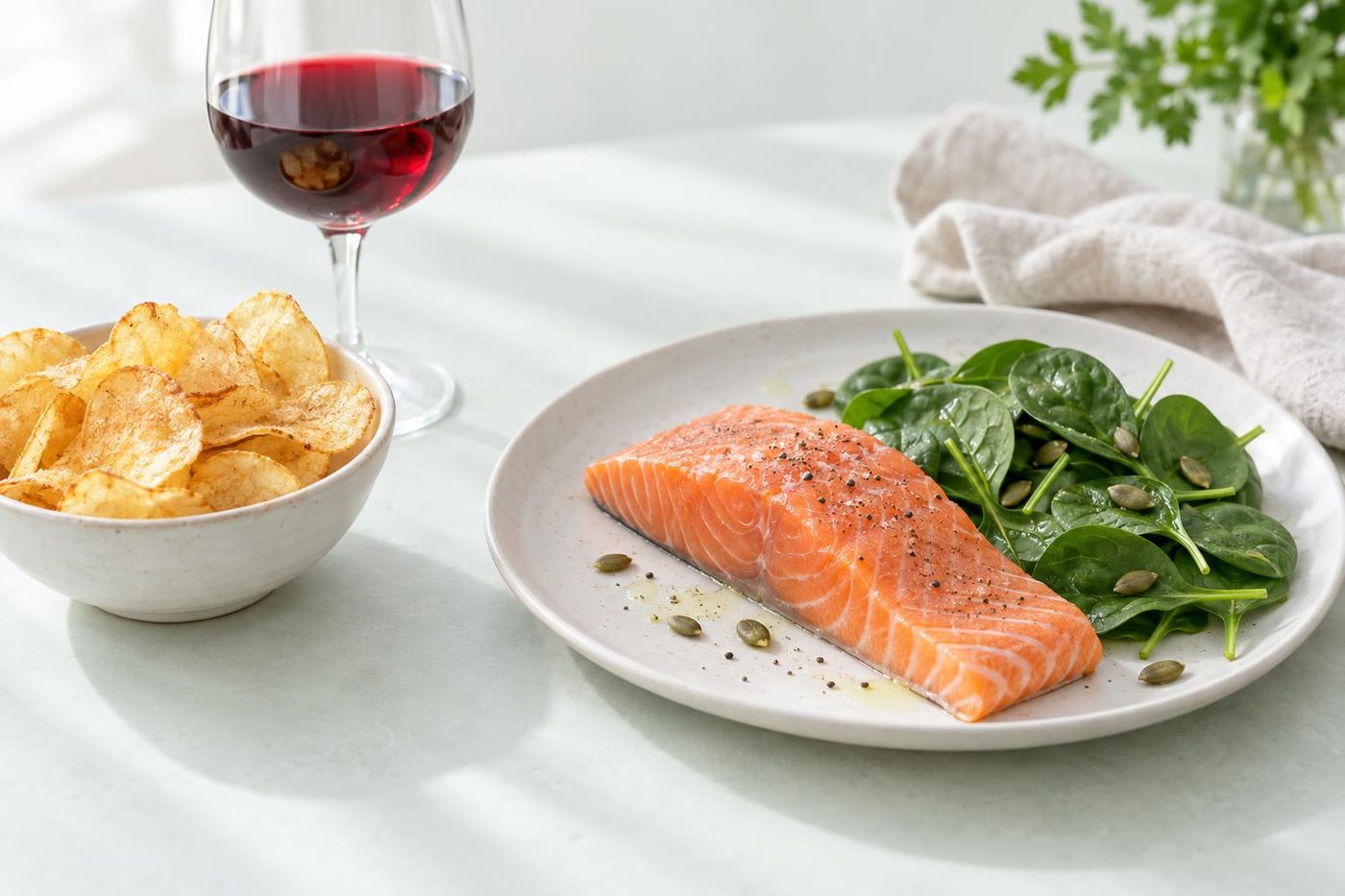
PRAL only shows how much acid or base a food leaves behind for your kidneys. It is calculated from five nutrients: protein, phosphorus, potassium, magnesium and calcium. Alcohol, sugar, fat, salt and calories are not part of the formula. That is why potato chips, at −17.0 per 100 g, are more alkaline on paper than fresh spinach (−12.2), and why wine, sparkling wine and beer look slightly alkaline. On the flip side, salmon, rolled oats and lentils are acid-forming and still valuable. Green means: adds no acid load. It does not mean: healthy.
Where the question comes from
We got a question that many of you probably have too: Why does the app show beer, wine and sparkling wine in green? Alcohol as an alkalizing food doesn’t fit with what we know about healthy eating.
The question is fair, and the answer is not an excuse. The color in the app and in the alkaline food list shows exactly one thing: the PRAL value. What it measures, it measures well. What it doesn’t measure, you need to know, or the colors will mislead you.
What PRAL calculates and what it doesn’t
The formula after Remer and Manz (1995), per 100 g:
PRAL = 0.49 × protein (g) + 0.037 × phosphorus (mg) − 0.021 × potassium (mg) − 0.026 × magnesium (mg) − 0.013 × calcium (mg)
- In the formula: Protein and phosphorus make the value positive (acid-forming). Potassium, magnesium and calcium make it negative (alkalizing).
- Not in the formula: alcohol, sugar, fat, salt, calories, fiber, vitamins, omega-3 fatty acids and the degree of processing.
This is not a flaw in the formula. It was built for one single question: How much acid do the kidneys have to excrete after a meal? For that, it works, as your urine pH shows. Judging how healthy a food is was never its goal. For a detailed look at how the formula works: PRAL explained.
Green or neutral, but not healthy
These foods sit on the alkaline or neutral side of the Basentracker database. The middle column shows what PRAL overlooks in each case.
| Food | What PRAL misses | PRAL per 100 g/ml |
|---|---|---|
| Potato chips | Frying fat, salt, 526 kcal | −17.0 |
| French fries (fast food) | Frying fat, salt | −11.4 |
| Ketchup | Sugar, salt | −6.5 |
| Maple syrup | Sugar | −6.2 |
| Dark chocolate | Fat, sugar, 563 kcal | −6.1 |
| Milk chocolate | Sugar, fat, 555 kcal | −2.1 |
| Chocolate hazelnut spread | Sugar, fat, 530 kcal | −1.9 |
| Red wine | Alcohol | −1.6 |
| White wine | Alcohol | −1.0 |
| Sparkling wine, dry | Alcohol | −0.7 |
| Beer | Alcohol | −0.4 |
| Table sugar | Pure sugar | 0.0 |
| Energy drink | Sugar, caffeine | 0.0 |
| Vodka | Alcohol | +0.2 |
| Coke | Sugar | +0.5 |
The pattern is always the same. The plant brings potassium: the potato in chips and fries, the tomato in ketchup, the cocoa in chocolate, the grape in wine. What gets added on top, meaning fat, sugar, salt or alcohol, doesn’t count in the calculation. Pure sugar and pure alcohol contain neither minerals nor protein, so they land at zero.
The individual answers with all variants: Are chips alkaline?, Are fries alkaline?, Is alcohol alkaline?, Is beer alkaline?, Is wine alkaline?, Is Coke alkaline?, Is sugar alkaline?, Is chocolate alkaline?.
Why chips are more alkaline than spinach
Boiled potatoes come in at −6.5 per 100 g. When they are fried, almost all the water evaporates, while the potassium stays and becomes concentrated. That’s how chips reach −17.0. The same effect puts tomato paste (−21.2) and dried apricots (−21.8) at the top of the list, even though fresh apricots sit at −7.2.
So the value per 100 g favors anything dry and dense. Calculate per 100 kcal, and the picture flips:
| Food | PRAL per 100 g | PRAL per 100 kcal |
|---|---|---|
| Spinach, fresh | −12.2 | −67.5 |
| Arugula | −7.1 | −33.6 |
| Carrot | −6.3 | −15.8 |
| Potato, boiled | −6.5 | −8.6 |
| French fries (fast food) | −11.4 | −4.8 |
| Potato chips | −17.0 | −3.2 |
Per calorie, fresh spinach is about 20 times as alkaline as chips. To match the value of 100 g of spinach (18 kcal) with chips, you would need 71 g of chips, or 375 kcal. A handful of chips (30 g) brings −5.1 at 158 kcal; a 100 g carrot manages −6.3 with 40 kcal.
Alcohol: why wine is green and vodka isn’t
| Drink | PRAL per 100 ml |
|---|---|
| Red wine | −1.6 |
| White wine | −1.0 |
| Sparkling wine, dry | −0.7 |
| Prosecco | −0.7 |
| Beer | −0.4 |
| Gin | +0.1 |
| Rum | +0.1 |
| Whisky | +0.1 |
| Vodka | +0.2 |
The table answers the question from the start. Wine, sparkling wine and beer bring potassium from grapes and malt and hardly any protein, hence the slightly negative values. Spirits such as vodka, gin, rum and whisky contain almost nothing but alcohol and water after distillation, so they land at zero. If alcohol were the reason for the green, vodka would have to be the most alkaline drink. It is neutral. The green comes from the grape, not from the alcohol.
What PRAL doesn’t see when it comes to alcohol:
- Liver and metabolism: Your liver breaks down alcohol, and that has nothing to do with the acid-base balance of your food.
- Minerals: Under the influence of alcohol, the kidneys excrete more magnesium and calcium.
- Sleep and calories: Alcohol makes your sleep worse. A glass of red wine (150 ml) has 105 kcal.
- Real acidosis: With chronic heavy drinking, the blood can actually become too acidic. This is called alcoholic ketoacidosis. It is a medical emergency that no food table can capture.
Since its position paper of August 2024, the German Nutrition Society (DGE) sees no risk-free amount of alcohol and recommends avoiding alcoholic drinks.
Can wine be part of a diet with an alkaline surplus? On paper, yes. A glass of red wine brings −2.4 and half a liter of beer −2.1, which barely shifts your daily balance. So the acid-base balance is no reason to drink wine, and no reason to avoid it either. If you drink less, do it for your liver, your sleep and your cancer risk. Those are the better reasons.
Red, but valuable
The mistake works the other way too. Protein and phosphorus make the PRAL value positive, and that’s exactly why some of the most valuable foods sit on the acid-forming side.
| Food | What PRAL misses | PRAL per 100 g |
|---|---|---|
| Pumpkin seeds | Magnesium, unsaturated fatty acids | +17.0 |
| Salmon, prepared | Omega-3 fatty acids, vitamin D | +11.5 |
| Almonds | Fiber, vitamin E | +10.5 |
| Rolled oats | Fiber (beta-glucan) | +6.8 |
| Chia seeds | Fiber, omega-3 fatty acids | +6.3 |
| Lentils, boiled | Protein, fiber | +3.1 |
| Wholemeal bread | Fiber | +2.6 |
| Plain yogurt, 3.5% | Calcium, protein | +0.5 |
The best example: a handful of pumpkin seeds (30 g) brings +5.1, and a handful of chips (30 g) brings −5.1. By PRAL, they cancel each other out exactly. Yet only one of the two is healthy.
If you cut these foods because they show up red, you eat worse, not better. The solution is the combination on your plate. Two meals from the database show how little the colors alone say about quality:
TV night
- Potato chips naturale · 100 g −17.0
- Beer · 500 ml −2.1
Salmon with potatoes and spinach
Both meals are alkaline, and TV night is even slightly more so. The second one provides protein, omega-3 fatty acids and vegetables. The colors see none of that.
Acid-forming and still worth eating: Is salmon alkaline?, Are oats alkaline?, Are nuts alkaline?, Are almonds alkaline?, Are lentils alkaline?. How to combine protein and a good balance: High-protein eating without an acidic balance.
What the critics of the alkaline diet get right
The alkaline diet has a bad reputation among many experts, and part of the criticism is justified.
Justified:
- Your diet does not change your blood pH. Your body keeps it between 7.35 and 7.45, no matter what you eat. More on this: Acid-base balance.
- “Being too acidic” as a cause of fatigue, skin problems or muscle tension is not supported by evidence. More on this: Being too acidic: symptoms and what’s behind them.
- Healthy people don’t need alkaline powders or high-pH “alkaline water.” More on this: Alkaline water.
- A color code based on PRAL alone can be misleading, as chips, wine and salmon show in this article.
Still true:
- The acid load of food is measurable. It determines how much acid your kidneys excrete, and that shows up in your urine pH.
- It plays a role in some conditions, such as kidney stones and gout.
- The practical core matches general recommendations: more vegetables, fruit, potatoes and legumes, less sausage, meat and cheese. You don’t need the idea of being too acidic for that.
How to read the colors correctly
- Green means: no acid load. It does not mean “healthy,” and it does not mean “eat more of it.”
- The amount matters. A handful of chips (30 g) brings −5.1, a serving of boiled potatoes (200 g) −13.1. The value per 100 g is only the starting point.
- Your daily balance matters, not the single food. Salmon, rolled oats and nuts belong in a good diet. Vegetables and potatoes on the same plate balance them out.
- Health calls for other yardsticks too: little sugar, little alcohol, little highly processed food. Where both overlap, in vegetables, fruit, potatoes and herbs, you find the core of a good alkaline diet.
ℹ️ Red values in your food diary
An acid-forming food is not a mistake. What matters is the bottom line at the end of the day, and that is mostly determined by your vegetable servings.
Frequently Asked Questions
Why does Basentracker show wine, beer and sparkling wine in green?
Because the app shows the PRAL value, and PRAL only calculates with protein, phosphorus, potassium, magnesium and calcium. Wine, sparkling wine and beer bring potassium from grapes and malt and hardly any protein, hence slightly negative values (red wine −1.6, sparkling wine −0.7, beer −0.4 per 100 ml). Alcohol is not part of the formula. Green here means: no acid load, not a recommendation.
Is alcohol alkaline?
Alcohol itself is neutral. Vodka, almost nothing but alcohol and water, comes in at +0.2 per 100 ml, and gin, rum and whisky at +0.1. Only drinks with minerals from grapes or malt are slightly alkaline, meaning wine, sparkling wine and beer.
Can wine be part of a diet with an alkaline surplus?
On paper, yes: a glass of red wine (150 ml) brings −2.4 and barely shifts your daily balance. For your health, that is no argument for wine: the DGE sees no risk-free amount of alcohol and recommends avoiding it.
Are chips alkaline?
By PRAL, yes: −17.0 per 100 g. When fried, the potato loses its water and the potassium becomes concentrated. A handful (30 g) brings −5.1 at 158 kcal, a carrot (100 g) −6.3 at 40 kcal.
Are fries alkaline?
Yes. Fast-food fries come in at −11.4 and oven-baked frozen fries at −6.8 per 100 g. Per calorie, though, boiled potatoes deliver almost twice the alkaline surplus (−8.6 versus −4.8 per 100 kcal) and no frying fat.
Is Coke acidic?
Barely: +0.5 per 100 ml, and a can (330 ml) brings +1.7. That is due to the phosphoric acid. The main problem with Coke is the sugar, and sugar does not show up in the PRAL value.
Is an alkaline diet a good idea?
As a guideline, yes. As a promise of healing, no. More vegetables, fruit, potatoes and legumes and less sausage and cheese is a good diet even without PRAL. Healthy people are not too acidic in a way that would need treating with alkaline powders.
PRAL values and calories: Basentracker food database, PRAL calculated after Remer and Manz (see Sources). Alcohol: German Nutrition Society (DGE), position paper on alcohol intake, August 2024.
Your acid-base balance, honestly calculated.
Basentracker adds up the PRAL of every meal using your real portions. The color shows the acid load, no more and no less.
Free for Android · iPhone coming soon
Bottom line
PRAL answers one question well: How much acid does a food leave behind? For chips, wine and sugar, the answer is “not much,” and that is correct. It does not tell you whether a food is healthy. The colors are a compass for your acid-base balance, not a verdict on your plate. You do best when you bring both together: plenty of vegetables, fruit and potatoes, protein-rich foods in sensible amounts, and little sugar and alcohol.