Urine pH Test at Home: How to Test Your Body pH and What It Shows
Basentracker Team
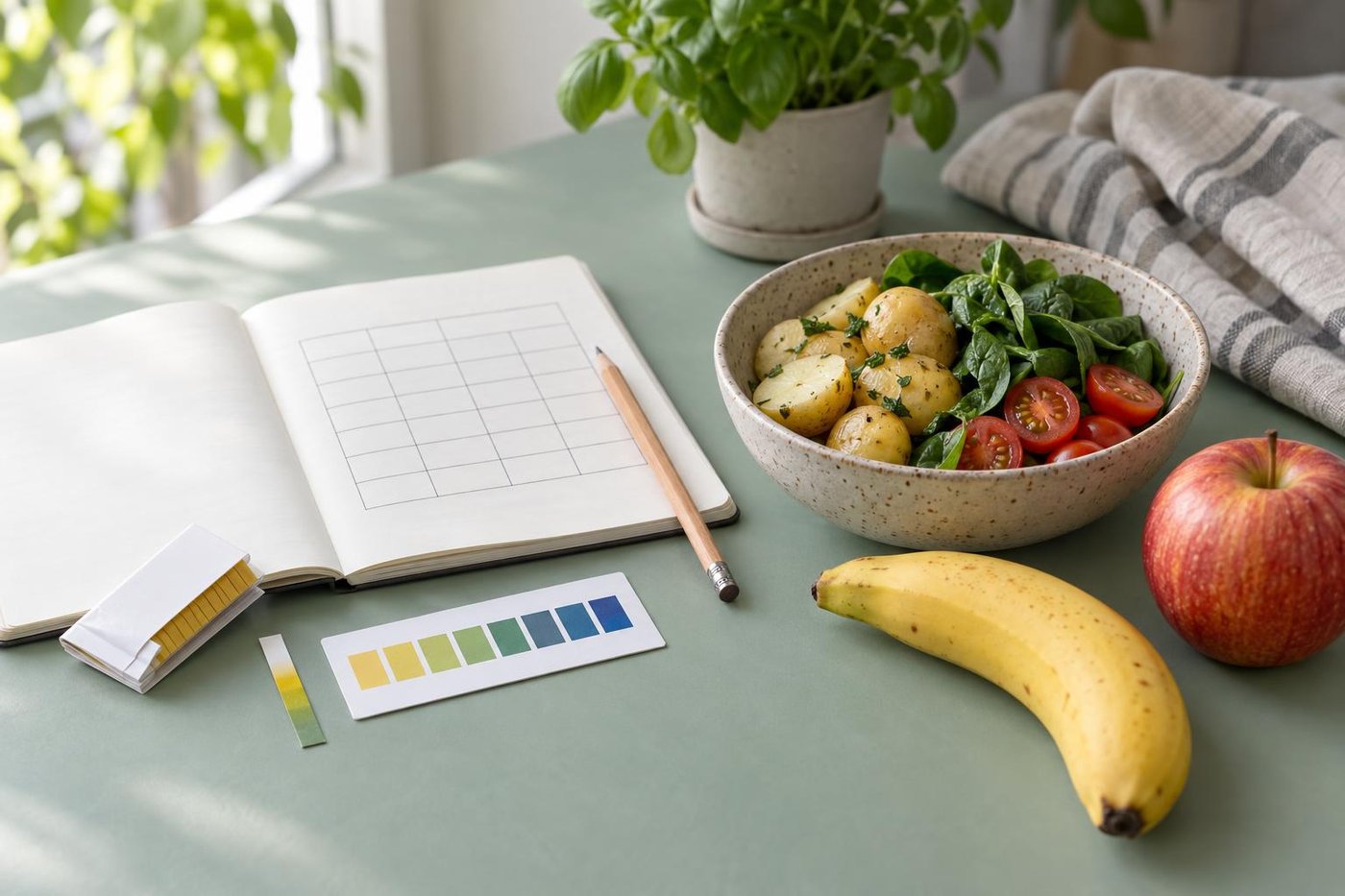
A home urine pH test measures the pH of your urine, not of your body. In healthy people, blood pH always stays between 7.35 and 7.45. Urine, on the other hand, swings between about 5 and 8, depending on how much acid your kidneys are excreting at the moment. A large part of that acid comes from food, and that is exactly what the PRAL value describes. The test only becomes meaningful as a series: four readings a day for seven days, with what you ate written down next to them. It cannot diagnose an acidic body in the medical sense.
What a urine pH test measures, and what it doesn’t
Test strips show how acidic your urine is right now. Urine is how your kidneys get rid of excess acid. So acidic urine doesn’t mean your body is acidic. It means your kidneys are excreting acid, which is their job.
What the test can’t do:
- Show your blood pH. It always stays between 7.35 and 7.45; buffers, lungs and kidneys keep it there. How that works: Acid-Base Balance Explained.
- Diagnose an acidic body. True acidosis is an acute medical condition that doctors identify with a blood gas test. Fatigue or muscle tension usually have other causes: Acidic Body Symptoms: What’s Behind Them.
- Tell you much from a single reading. A morning strip shows the acid from the night, one after lunch shows the acid from your last meal.
Saliva tests tell you even less. Saliva pH mostly depends on what you ate or drank in the last few minutes.
What the test can do: over several days, it shows whether your diet leans acid-forming or alkaline-forming, and whether a change on your plate shows up in your urine. What individual readings mean: Urine pH Normal Range and Daily Changes.
Urine pH test strips: how to read them
You can buy urine pH test strips at drugstores and pharmacies, usually as a roll or a booklet with a color chart. They differ mainly in range and resolution. Many cover pH 5 to 8 in steps of 0.2 to 0.5. That is enough for a home test, because what matters is the trend, not the second decimal place.
How to read them correctly:
- Use midstream urine. Hold the strip briefly in the stream or dip it into freshly collected urine.
- Read it right away, at the latest after the time printed on the package. Urine that sits loses CO₂ and becomes more alkaline.
- Compare in daylight. If the color falls between two fields, write down the value in between.
- Keep them dry. Close the roll or container after tearing off a strip; damp strips discolor and give wrong readings.
ℹ️ Alkaline powder skews the test
Citrates and bicarbonate in alkaline powder raise urine pH directly, often within a few hours. If you take alkaline powder, you are mainly measuring the powder, not your diet. For a meaningful test, do the week without it or note it in your log. More: Alkaline Powder: What’s in It and Does It Work?
How to test your body pH: the 7-day home test
Four readings a day:
- First morning urine, right after getting up. It shows what your kidneys excreted overnight and is almost always the most acidic reading.
- Before lunch.
- Two hours after lunch.
- In the evening before bed.
Write down next to it: what you ate, with rough amounts. That gives you the day’s PRAL balance. Also note anything else that moves the reading: alkaline powder, medication, hard exercise, drinking much more or less than usual.
Seven days, one change: For the first three days, eat as usual. That is your baseline. From day four, change one thing: add a large serving of vegetables or potatoes to every main meal and have fruit as a snack. By day five or six you will see whether the curve shifts.
If you are planning an alkaline fast anyway, you can build the test around it: measure for three days before, then during the fast. A plan for that: Alkaline Fasting: 7-Day Plan with Recipes.
Why your plate moves the reading: the PRAL value
The PRAL value (potential renal acid load) estimates how much acid a food leaves for your kidneys after digestion. Protein and phosphorus raise it; potassium, magnesium and calcium lower it. A positive value means acid-forming, a negative value alkaline-forming. Taste has nothing to do with it: lemon tastes sour and is alkaline-forming.
The value was developed for exactly the question your test strip asks. In 1995, nutrition researchers Thomas Remer and Friedrich Manz showed that the PRAL of foods predicts how acidic urine becomes. PRAL predicts, the strip confirms.
For your urine, the total for the day is what counts, not any single food. A piece of cheese changes little if vegetables and potatoes fill the rest of the plate.
Two days compared
Two days with almost the same calories, both with bread and cheese. The values come from the Basentracker database.
Day A: bread rolls, pasta and sausage (about 1,700 kcal)
| Meal | What | PRAL |
|---|---|---|
| Breakfast | 2 white bread rolls (120 g), Gouda (30 g), cooked ham (30 g), coffee with milk (200 ml) | +11.5 |
| Lunch | Spaghetti (250 g) with ground beef (100 g), tomato passata (100 g) and Parmesan (15 g) | +27.0 |
| Dinner | Wholemeal bread (100 g), salami (30 g), Gouda (30 g), cucumber (50 g) | +10.5 |
| Day | +49.0 |
Day B: vegetables, potatoes and fruit (about 1,660 kcal)
| Meal | What | PRAL |
|---|---|---|
| Breakfast | Rolled oats (60 g) with milk (200 ml) and banana (120 g), coffee with milk (200 ml) | −7.8 |
| Lunch | Salmon (150 g), boiled potatoes (250 g), spinach (150 g) | −18.5 |
| Dinner | Wholemeal bread (100 g), Gouda (30 g), tomato, cucumber and bell pepper (100 g each) | −3.2 |
| Snack | Apple (150 g), walnuts (30 g) | −1.2 |
| Day | −30.6 |
Day B includes fish, cheese and oats, three acid-forming foods, and still ends up at −30.6. The difference from day A is the potatoes, spinach, raw vegetables and fruit next to the protein.
After a day like A, your strip will tend to read low in the evening and the next morning; after a few days like B, higher. PRAL can’t give you exact pH values, because those also depend on how much you drink, the time of day and your kidneys. The direction, however, is well established.
You can calculate your own meals with the PRAL calculator and look up single foods in the alkaline food list.
How to read your results
- Below 6 in the morning, up to 7 during the day: normal. A daily profile that moves between 5.5 and 7.0 is unremarkable.
- Below 6 all day, for several days: points to an acid-forming diet. If the PRAL balance of those days is clearly positive, that is the obvious explanation.
- The curve rises after the change: vegetables, potatoes and fruit affect your urine, and within a few days. This has nothing to do with clearing acid out of your body; your blood pH was normal before and after.
- No change despite the switch: check your log. Often the balance was less alkaline than expected, for example because bread, cheese or pasta filled most of the plate.
⚠️ When your results are a reason to see a doctor
Consistently below 5 despite eating plenty of vegetables, consistently above 8 with burning when you urinate, known kidney stones or gout: in these cases your doctor decides which urine pH makes sense. With reduced kidney function, more vegetables and fruit also means more potassium. Talk to your doctor before changing your diet: Kidney Disease Diet.
Read more: Urine pH Normal Range and Daily Changes, What Is PRAL? Meaning and Formula, Acidic Foods List, Alkaline Foods Chart with PRAL Values.
Frequently Asked Questions
Can a urine pH test show if my body is too acidic?
No. Test strips measure the pH of your urine, not your blood. Acidic urine shows that your kidneys are excreting acid, which is their normal job. True acidosis is an acute condition that doctors identify with a blood gas test.
What is a normal urine pH?
In healthy people, urine pH ranges from about 4.5 to 8.0, with a daily average around 6.0. It is usually lowest in the morning and rises after meals. A daily profile between 5.5 and 7.0 is normal.
Which urine pH test strips should I buy?
Strips from drugstores and pharmacies differ little. Look for a range of about pH 5 to 8 and steps of 0.2 to 0.5. More important than the brand: read them right away in daylight, keep them dry and test regularly over several days.
When should I test my urine pH?
Four times a day: first morning urine, before lunch, two hours after lunch and in the evening. The first morning urine alone is almost always acidic and tells you little. Only the curve over five to seven days shows how your diet affects it.
Urine or saliva: which pH test is more accurate?
Urine. Saliva pH mostly depends on what you ate or drank in the last few minutes. It says almost nothing about the acid load of your diet.
Is there a blood test for an acidic body?
Yes, a blood gas test at the doctor’s office. It measures blood pH, bicarbonate and base excess. In healthy people it is normal, even on an acid-forming diet. You don’t need it for diet questions.
How fast does diet change urine pH?
Within hours after a meal. Switching to more vegetables, potatoes and fruit shows up in the daily profile after two to three days.
What does PRAL have to do with urine pH?
PRAL estimates how much acid a food leaves for your kidneys after digestion. The higher the PRAL total for a day, the more acidic your urine gets. That is exactly what the value was developed for in 1995.
Sources: PRAL values: Basentracker food database, October 2026, calculated according to Remer and Manz (see Sources). Remer T, Manz F: Potential renal acid load of foods and its influence on urine pH. Journal of the American Dietetic Association 1995; 95: 791–797.
Your 7-day test: the app does the math.
Log what you eat. Basentracker calculates the PRAL of every meal and shows your daily balance and your trend over seven days. So every test strip has the matching number next to it.
Free for Android · iPhone coming soon
Conclusion
A urine pH test measures your urine, not your body. A single reading is worthless; a series over seven days is a useful mirror of your diet. What moves it is the acid load of your food, and that is what PRAL describes. If you want to change the reading, change your plate: more vegetables, potatoes and fruit next to bread, cheese and meat. The strip won’t find an acidic body, but it will find an acid-forming week.