Alkaline Powder: What's in It and Does It Actually Work?
Basentracker Team
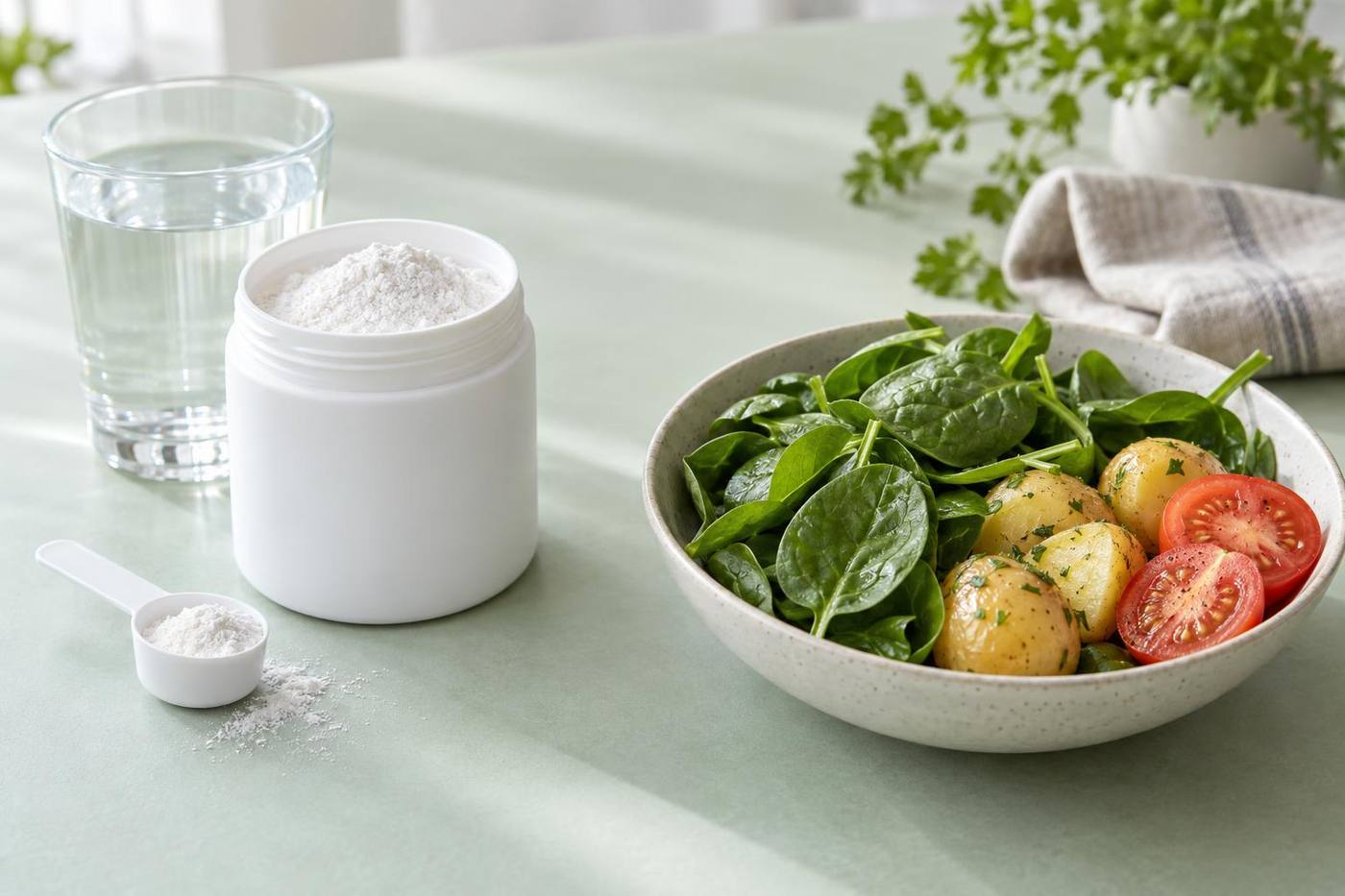
Alkaline powder is a blend of mineral salts: usually citrates or carbonates of potassium, magnesium and calcium, and almost always zinc. By calculation, one daily dose provides about −18 to −25 in base, as much as 150 g of cooked spinach. Healthy people don’t need it: the German consumer magazine Öko-Test found no benefit in 32 products, and the EU has not authorized health claims for citrates and carbonates because the evidence was lacking. At most, alkaline powder makes sense on a doctor’s advice. For people with kidney disease or medications that raise potassium, it can be dangerous. Vegetables and potatoes provide the same base, plus fiber and vitamins.
What’s in alkaline powder
Ingredient lists vary, but the principle is the same for almost every product. They contain alkalizing salts of minerals that are also found in vegetables, fruit and potatoes.
| Ingredient | What it does in the body |
|---|---|
| Potassium citrate | The citrate is broken down into bicarbonate, the body's own buffer. Potassium is the most important alkalizing mineral. |
| Magnesium citrate or carbonate | Alkalizing, but only partly absorbed. Laxative in larger amounts. |
| Calcium citrate or carbonate | The least well absorbed. Carbonate also binds stomach acid. |
| Sodium bicarbonate (baking soda) | Strongly alkalizing, but brings a lot of sodium: 1 g of baking soda contains 274 mg of sodium. |
| Zinc | Adds hardly any base. It is in the tub for a legal reason (see below). |
Depending on the product, silica, herbal extracts or vitamins are added. For your acid-base balance, only the minerals and their citrates, carbonates and bicarbonates count.
The logic is the same as with the PRAL: potassium, magnesium and calcium shift the balance toward alkaline, protein and phosphorus toward acidic. Alkaline powder only supplies the alkaline side, with no protein and no phosphorus.
What about alkaline greens powders?
“Alkaline greens” are a different product: dried vegetables, grasses and algae, often mixed with fruit powder. Dried plants are rich in potassium, so they lean alkaline. But a serving is a few grams, not a plate of vegetables, and the label rarely tells you how much potassium you get. If a greens powder lists potassium, magnesium and calcium per serving, you can estimate it the same way as below.
How much base one daily dose provides
We converted the amounts per daily dose of three widely sold alkaline powders using the mineral factors of the PRAL formula and set them next to foods from the Basentracker database.
| What | Amount | Base or PRAL |
|---|---|---|
| Alkaline powder, label 1: potassium 600 mg, magnesium 360 mg, calcium 260 mg | 1 daily dose | about −25 |
| Alkaline powder, label 2: potassium 420 mg, magnesium 150 mg, calcium 900 mg | 1 daily dose | about −24 |
| Alkaline powder, label 3: potassium 350 mg, magnesium 200 mg, calcium 400 mg | 1 daily dose | about −18 |
| Spinach, cooked | 150 g | −19.4 |
| Potatoes, boiled | 200 g | −13.1 |
| Lamb's lettuce | 100 g | −8.3 |
| Banana | 1 medium (120 g) | −7.6 |
| Chicken breast, cooked | 150 g | +19.8 |
Alkaline powder estimated with the mineral factors of the PRAL formula by Remer and Manz (0.021 × potassium + 0.026 × magnesium + 0.013 × calcium, per mg), without zinc. This is an estimate based on label data, not a value from our database. Foods: Basentracker food database.
So one daily dose of alkaline powder equals a large serving of vegetables. By calculation, it offsets one portion of chicken breast, nothing more. If you eat potatoes with spinach for lunch, you get the same amount without any powder:
Potatoes with spinach and egg
Raw veggie box to go
- Carrot · 100 g −6.3
- Red bell pepper · 100 g −3.5
- Cucumber · 100 g −3.3
- Tomato · 100 g −4.2
What studies and testers say
- Your urine becomes more alkaline. You can see this with test strips, and it is why doctors prescribe potassium citrate for certain kidney stones. Alkaline urine does not mean your body was “too acidic” before. More: Urine pH explained.
- Your blood pH does not change. Your body keeps it between 7.35 and 7.45, with or without powder. More: Acid-base balance.
- For bones, the studies disagree. In adults over 65, lumbar spine bone density was 1.7% higher with potassium citrate than with a placebo after two years (Jehle 2013). In postmenopausal women, two years of potassium citrate made no difference compared with a placebo (Macdonald 2008).
- The EU has not authorized the health claims. No manufacturer in the EU may claim that citrates, carbonates or bicarbonates support acid-base balance or bones. The European Food Safety Authority (EFSA) found the evidence insufficient in 2011.
- Öko-Test found no benefit. In its test of 32 alkaline supplements, no product scored better than “poor”. The testers’ conclusion: healthy people get no benefit from taking them.
Why almost every product contains zinc
Many labels say: “Zinc contributes to normal acid-base metabolism.” This is a health claim authorized in the EU. But it applies only to zinc, not to the citrates and carbonates that make up most of the powder.
Manufacturers add zinc so they are allowed to say anything about acid-base balance at all. The sentence says nothing about what the powder does. Zinc is also found in whole grains, oats, cheese, meat and legumes.
Who might consider alkaline powder and who should not
⚠️ Caution with kidneys and medications
Alkaline powder contains a lot of potassium. With kidney disease or medications that raise potassium levels (for example ACE inhibitors, ARBs or potassium-sparing diuretics), too much potassium in the blood can become dangerous. Only take it after talking to your doctor. Powders with baking soda are a poor choice with high blood pressure or a low-sodium diet.
- Kidney stones: Here potassium citrate is a medication, and the dose is set by your doctor. An over-the-counter alkaline powder is no substitute. More: Kidney stone diet.
- Gout: Alkaline urine helps dissolve uric acid. Treatment belongs in medical hands here, too. More: Gout diet.
- Chronic kidney disease: An alkali therapy can make sense under medical supervision, but an over-the-counter powder with lots of potassium can be dangerous. More: Kidney disease diet.
- Healthy people: No proven benefit. If you want to improve your balance, vegetables get you further and add fiber and vitamins.
Common side effects are bloating, burping and gas from carbonates, and loose stools from magnesium.
Alkaline powder for fasting and weight loss
Many people buy alkaline powder for an alkaline fasting week or to lose weight. During alkaline fasting, the effect comes from the food: lots of vegetables, no meat, no cheese, no white flour. The powder doesn’t change that. More: Alkaline fasting plan.
It doesn’t help with weight either. Alkaline powder has almost no calories, but it doesn’t burn fat and it doesn’t keep you full. What really counts when you lose weight on an alkaline diet: Alkaline diet for weight loss.
Keep reading: Alkaline water: what actually works, Alkaline diet myths, Acidic body symptoms, Is spinach alkaline?, Are potatoes alkaline?, The alkaline food list with every food.
Frequently Asked Questions
Do you need alkaline powder?
Healthy people don't. Your body keeps its blood pH constant on its own, and you can offset the acid load of your diet with vegetables, fruit and potatoes. Öko-Test found no benefit for healthy people in 32 products.
What does alkaline powder do?
By calculation, it provides about −18 to −25 in base per daily dose, as much as 150 g of cooked spinach (−19.4). Your urine becomes more alkaline. So far, no one has shown a benefit for healthy people, for example for bones or well-being, convincingly enough for the EU to authorize a health claim.
When should you take alkaline powder?
For your acid-base balance, the timing doesn't matter, only the daily amount. If you take it, follow the dose on the label. If you take medications, ask your pharmacist whether you need to space them apart.
Does alkaline powder have side effects?
Bloating, burping and gas from carbonates and loose stools from magnesium are common. The potassium can become dangerous with kidney disease and with medications that raise potassium levels.
Does alkaline powder help with weight loss?
No. It has almost no calories, but it doesn't burn fat and doesn't keep you full. People lose weight during alkaline fasting because they eat less and more vegetables.
Can you put alkaline powder in water?
Yes, most powders are meant to be dissolved in water. This doesn't change the effect: what counts is the potassium, magnesium and calcium per daily dose, not the pH of the drink. More in our article on alkaline water.
Can you use baking soda instead of alkaline powder?
Baking soda is strongly alkalizing: by calculation, 1 g provides almost 12 millimoles of base. But it contains 274 mg of sodium per gram and binds stomach acid. As a long-term habit or as self-treatment, that is not a good idea.
Sources: Öko-Test, test of alkaline supplements (Jahrbuch 2016). EFSA opinion on sodium and potassium citrate and bone (EFSA Journal 2011;9(6):2302). Jehle et al., J Clin Endocrinol Metab 2013;98(1):207. Macdonald et al., Am J Clin Nutr 2008;88(2):465–474. Zinc: Regulation (EU) No 432/2012. PRAL values: Basentracker food database, calculated according to Remer and Manz (see Sources). Label data as of October 2026.
Your base comes from your plate.
Basentracker calculates the PRAL of every meal with your real amounts. So you can see whether your day is already alkaline before you think about powders.
Free for Android · iPhone coming soon
Conclusion
Alkaline powder supplies mineral salts that, by calculation, provide as much base as a large serving of vegetables. Nothing more. Healthy people get no proven benefit, and for people with kidney disease or certain medications the potassium can be dangerous. If you want to improve your acid-base balance, start with your plate: potatoes, spinach, salad and fruit provide the same base and much more.