Alkaline Foods for Acid Reflux: 15 Foods Checked for pH and PRAL
Basentracker Team
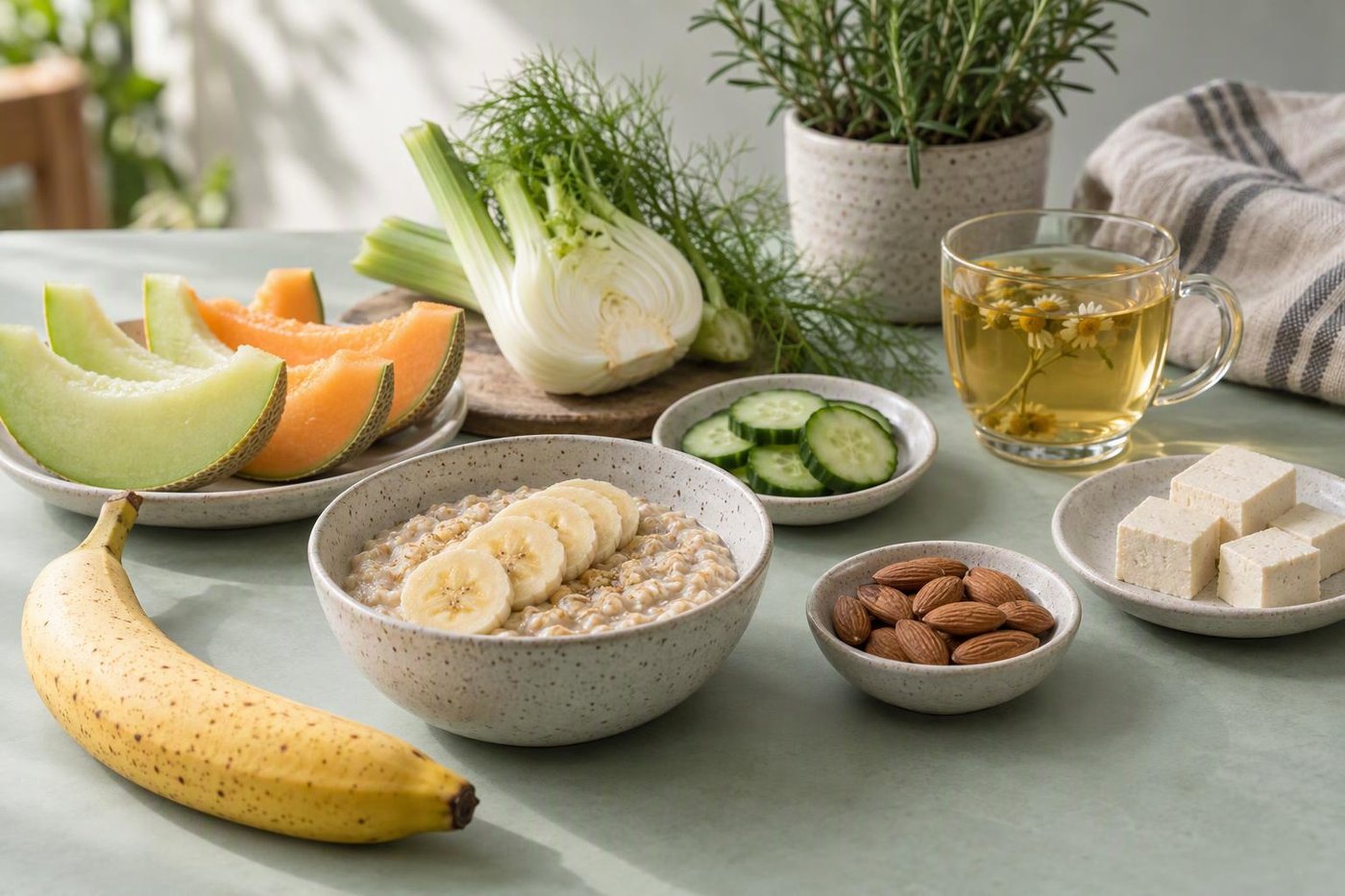
Lists of “alkaline foods for acid reflux” almost always include bananas, melon, oatmeal, almonds, ginger, fennel and green vegetables. Hardly any of them is literally alkaline: of the nine foods on this list with a measured pH, only tofu is above 7. By PRAL, oats, almonds, tofu and chicken breast are even acid-forming. Most of them are still well tolerated, but for a different reason: they are mild, low in acid and mostly low in fat. For acid reflux, fat, portion size, meal timing and alcohol matter more than any alkaline food list.
Three meanings of “alkaline”
If you look for alkaline foods because of heartburn, you usually mean something different from what the lists give you. “Alkaline” can mean three things:
- In the glass: pH. It shows how acidic a food itself is. 7 is neutral, below that is acidic, and each step means ten times more acid. For an irritated esophagus, this is the number that burns.
- After metabolism: PRAL. It describes what is left for your kidneys after digestion. Lemon is acidic in the glass and alkaline-forming in metabolism. How the value is calculated: What Is PRAL?
- In the stomach: the effect on the valve. Whether a meal sits in your stomach for a long time or relaxes the valve at the top of the stomach depends mostly on fat, portion size and alcohol, not on pH and not on PRAL.
For acid reflux, the third meaning matters most, the first a little and the second practically not at all. What relaxes the valve and what irritates the lining is covered in detail in the Acid Reflux Diet.
The typical list, fact-checked
These 15 foods come up again and again in recommendations for acid reflux. Next to each one: the pH of the food itself and its PRAL value from the Basentracker database.
| Food | pH | PRAL per 100 g | Verdict |
|---|---|---|---|
| Banana | 4.50–5.20 | −6.4 | mild, usually well tolerated |
| Melon (watermelon, honeydew, cantaloupe) | 5.18–6.67 | −1.7 to −5.4 | high in water, low in acid |
| Rolled oats | – | +6.8 | acid-forming and still one of the best-tolerated classics |
| Ginger, fresh | – | −6.7 | studied for nausea, hardly for reflux; spicy in large amounts |
| Almonds | – | +10.5 | acid-forming and high in fat; a handful (25 g, +2.6) is usually fine |
| Almond milk, unsweetened | – | −1.3 | low in fat and mild |
| Tofu, plain | 7.20 | +8.3 | the only food on the list above pH 7, acid-forming by PRAL |
| Chicken breast, cooked | – | +13.2 | acid-forming; lean and unbreaded, usually well tolerated |
| Fennel, boiled | – | −2.8 | mild |
| Cauliflower, boiled | 5.6 | −2.6 | mild, can cause bloating |
| Avocado | 6.27–6.58 | −9.9 | strongly alkaline-forming but high in fat; large servings can trigger symptoms |
| Celery | 5.70–6.00 | −5.2 | high in water, mild |
| Broccoli, boiled | 6.30–6.85 | −1.3 | mild, can cause bloating |
| Potato, boiled | 5.40–5.90 | −6.5 | starchy and low in fat; not fried |
| Cucumber | 5.12–5.78 | −3.3 | high in water, mild |
pH values: “pH Values of Common Foods and Ingredients”, Clemson Cooperative Extension; “–” means the table gives no value. PRAL values: Basentracker food database.
The result:
- Alkaline in the glass: only tofu, at pH 7.2. All other foods with a measured value fall between 4.5 and 6.9, so they are slightly acidic.
- Alkaline-forming by PRAL: 11 of the 15. Oats, almonds, tofu and chicken breast are acid-forming and still appear on almost every list.
- What almost all of them really share: little acid, no heat, no roasted compounds, no alcohol and, except for almonds and avocado, little fat.
What the lists get right
The lists aren’t wrong, they just give the wrong reason. No food on them is below pH 4.5. For comparison: lemon juice has a pH of 2.0 to 2.6, oranges 3.7 to 4.3. On average, lemon juice and banana are about two and a half pH steps apart, so a banana contains only a small fraction of the free acid.
A small study supports the idea that the pH of food plays a role: 20 patients with silent reflux whose symptoms persisted despite acid-suppressing medication cut out everything below pH 5 for two weeks. 19 of them improved (Koufman 2011). There was no control group, so the result is a hint, not proof.
The second reason is fat. Fat slows stomach emptying and relaxes the valve. Bananas, melon, potatoes, cucumber and cooked vegetables contain almost none. That is why almonds and avocado are the borderline cases on the list: a handful of almonds or half an avocado is usually fine, a large serving not always.
Alkaline-forming, but common triggers
If you choose foods for acid reflux by PRAL, you end up with several classic triggers. These foods are alkaline-forming by PRAL and still often cause symptoms:
| Food | pH | PRAL per 100 g | Why it can irritate |
|---|---|---|---|
| Lemon juice | 2.00–2.60 | −2.3 | very acidic in the glass |
| Pineapple | 3.20–4.00 | −2.6 | acidic |
| Orange | 3.69–4.34 | −2.8 | acidic, fruit acids |
| Tomato | 4.30–4.90 | −4.2 | acidic, ketchup and sauces even more so |
| Onion, raw | 5.30–5.88 | −2.4 | barely acidic, but irritates many people when raw |
| Dark chocolate | – | −6.1 | relaxes the valve, high in fat |
| Coffee, black | – | −2.3 | roasted compounds, stimulates acid production |
| Peppermint tea | – | −0.4 | relaxes the valve |
pH values: Clemson Cooperative Extension (onion: red, white and yellow varieties). PRAL values: Basentracker food database.
Lemon, tomato, chocolate and coffee: four of the best-known triggers are alkaline by PRAL. That is true for your kidneys and irrelevant for your esophagus. Single questions: Is lemon acidic or alkaline?, Are tomatoes acidic?, Is coffee acidic?
Alkaline water for acid reflux
Alkaline water with a pH of 8 to 9 is often recommended for acid reflux. What the data show:
- In the lab: water at pH 8.8 permanently inactivated human pepsin, the protein-digesting enzyme in stomach juice (Koufman and Johnston 2012). With tap and mineral water at pH 6.7 to 7.4, that is not to be expected, because pepsin stays stable at pH 7.4. The study did not involve patients.
- In practice: a review of patient records compared 85 patients with silent reflux on acid-suppressing medication with 99 patients on a 90 to 95 percent plant-based Mediterranean diet plus alkaline water. Symptoms improved similarly: in 62.6 percent of the diet group and 54.1 percent of the medication group, the symptom score dropped clearly, by at least six points (Zalvan and colleagues 2017). The study was retrospective, and the effects of the water and the diet cannot be separated.
So for acid reflux, alkaline water is an interesting lab finding, not a proven remedy. In normal amounts it does no harm. Non-carbonated tap water is the cheaper basis; carbonation, on the other hand, stretches the stomach. What else alkaline water can do: Alkaline Water: What’s True.
What really matters for acid reflux
The American College of Gastroenterology’s 2022 guideline gives a strong recommendation for only one thing: losing weight if you are overweight. Less well supported, but also recommended: no food two to three hours before bed, raising the head of the bed, not smoking and avoiding your own trigger foods. So instead of blanket lists of foods to avoid, it comes down to what you personally don’t tolerate.
In practice: smaller portions, less fat and alcohol, a gap before bed. A full day of eating with acid reflux is in the Acid Reflux Diet.
⚠️ When to see a doctor
Heartburn more than twice a week for several weeks, trouble swallowing, unintended weight loss, vomiting or black stools need to be checked. Ongoing reflux can damage the esophagus; acid-suppressing medication then works well and is often necessary.
Read more: Acid Reflux Diet, Acidic Foods List, Alkaline Diet Myths, Are oats acidic?.
Frequently Asked Questions
Which alkaline foods help with acid reflux?
No food helps because it is alkaline. Foods that are usually well tolerated are mild, low in acid and low in fat: bananas, melon, oatmeal, potatoes, fennel, cucumber and celery. Oats are even acid-forming by PRAL and still one of the classics.
Are bananas good for acid reflux?
Usually, yes. At pH 4.5 to 5.2 they are slightly acidic, but far less than citrus fruit. By PRAL they are alkaline-forming (−6.4 per 100 g), and they are mild and almost fat-free.
Are almonds good for acid reflux?
There is no evidence for it. Almonds are acid-forming by PRAL (+10.5 per 100 g) and about half fat. Most people tolerate a handful, chewed well. Larger amounts can make symptoms worse.
Why is lemon alkaline but bad for acid reflux?
Because “alkaline” means two different things here. In metabolism the fruit acid is broken down, leaving potassium and magnesium, so the PRAL value is negative. On its way down the esophagus, though, lemon juice at pH 2.0 to 2.6 is very acidic and irritates an already irritated lining.
Does alkaline water help acid reflux?
In the lab, water at pH 8.8 inactivated the digestive enzyme pepsin. Whether that works in patients has not been shown. In a retrospective study, a plant-based diet with alkaline water helped about as much as acid-suppressing medication, but the share of the water remained unclear.
Does an alkaline diet help with acid reflux?
In one study, a mostly plant-based Mediterranean diet did about as well as acid-suppressing medication for silent reflux. Whether that has anything to do with PRAL is unclear. What is certain: losing weight if you are overweight, smaller and lower-fat meals and a gap before bed help the most.
Is oatmeal good for acid reflux even though it is acid-forming?
Yes. Rolled oats have a PRAL of +6.8 per 100 g and are still among the best-tolerated foods for acid reflux: mild, low in fat and filling. PRAL tells you something about your kidneys, not about your stomach.
Sources: pH values: “pH Values of Common Foods and Ingredients”, Clemson Cooperative Extension. PRAL values: Basentracker food database, October 2026 (see Sources). Koufman JA: Low-acid diet for recalcitrant laryngopharyngeal reflux. Annals of Otology, Rhinology & Laryngology 2011; 120: 281–287. Koufman JA, Johnston N: Potential benefits of pH 8.8 alkaline drinking water as an adjunct in the treatment of reflux disease. Annals of Otology, Rhinology & Laryngology 2012; 121: 431–434. Zalvan CH et al.: A comparison of alkaline water and Mediterranean diet vs proton pump inhibition for treatment of laryngopharyngeal reflux. JAMA Otolaryngology–Head & Neck Surgery 2017; 143: 1023–1029. Katz PO et al.: ACG Clinical Guideline for the Diagnosis and Management of Gastroesophageal Reflux Disease. American Journal of Gastroenterology 2022; 117: 27–56.
Know the PRAL of every meal.
For your stomach, what counts is what you tolerate; for your kidneys, it is PRAL. Basentracker calculates it for every meal and the whole day, using your real amounts.
Free for Android · iPhone coming soon
Conclusion
The typical “alkaline” foods for acid reflux are almost all slightly acidic in the glass, and four of 15 are even acid-forming by PRAL. They are still usually well tolerated, because they are mild, low in acid and low in fat. On the other hand, lemon, tomato, chocolate and coffee are alkaline by PRAL and still cause symptoms. For acid reflux, smaller and lower-fat meals, a gap before bed and avoiding your own triggers help more than any alkaline food list. PRAL remains the right tool for your kidneys, not for your stomach.