What Is an Alkaline Diet? A Beginner's Guide With Numbers
Basentracker Team
An alkaline diet means eating mostly foods that leave bases behind after metabolism (vegetables, fruit, potatoes, herbs) and limiting foods that leave acid behind (cheese, meat, sausage, eggs, grains). This is measured with the PRAL value: negative is alkaline, positive is acid-forming. It’s not about giving things up. It’s about the ratio: roughly two-thirds alkaline, one-third acid-forming. Taste plays no role. Lemon is alkaline, and cheese is the most acid-forming food of all.
The idea in one paragraph
Everything you eat is digested and metabolized. Minerals are left over. Protein and phosphorus produce acids (sulfuric acid, phosphoric acid), while potassium, magnesium and calcium produce bases. Your kidneys excrete the excess. If you consistently eat more acid-forming than alkalizing foods, your kidneys have to get rid of acid every day, and your body draws bases from its stores to buffer it. An alkaline diet reverses this ratio without giving up protein.
That may sound like wellness talk, but it’s biochemistry that has been known for more than a hundred years. The wellness talk comes in with many of the promises attached to it. More on that below.
PRAL: the one number you need to know
PRAL stands for potential renal acid load, the potential acid load on your kidneys. The formula by Remer and Manz (1995) uses five nutrients per 100 g of food to calculate a single number:
- Acid-forming (plus): protein, phosphorus
- Alkalizing (minus): potassium, magnesium, calcium
Negative means alkaline, positive means acid-forming, and around zero is neutral. The value is per 100 g, so the portion matters too: 10 g of Parmesan (+3.0) is something very different from 100 g (+29.6).
| Food | PRAL per 100 g | Rating |
|---|---|---|
| Spinach, fresh | −12.2 | strongly alkaline |
| Avocado | −9.9 | strongly alkaline |
| Potato, boiled | −6.5 | strongly alkaline |
| Banana | −6.4 | strongly alkaline |
| Tomato | −4.2 | alkaline |
| Coffee, black | −2.3 | alkaline |
| Apple | −1.9 | alkaline |
| Sugar | 0.0 | neutral |
| Milk | +0.1 | neutral |
| Rice, cooked | +1.8 | slightly acid-forming |
| Wholemeal bread | +2.6 | slightly acid-forming |
| Lentils, boiled | +3.1 | slightly acid-forming |
| Rolled oats | +6.8 | acid-forming |
| Egg | +10.6 | acid-forming |
| Salmon | +11.5 | acid-forming |
| Chicken breast | +13.2 | strongly acid-forming |
| Gouda | +17.5 | strongly acid-forming |
Three things stand out that are new to most people: sugar is neutral, not acid-forming. Coffee is alkaline, not acidic. And cheese beats meat by a wide margin. If you want to eat alkaline, start with cheese, not coffee.
All 977 foods in the Basentracker database with values, search and filters: alkaline food list. Individual questions such as “Is coffee acidic?” or “Are oats acidic?” are answered in the Acidic or Alkaline? guide. How the value is calculated: PRAL explained. What happens in your body: Acid-base balance explained simply.
Tasting sour and being acid-forming are two different things
This is the most common mistake. Lemon, vinegar, tomato, sauerkraut and currants taste sour. But the fruit acids they contain are completely broken down into carbon dioxide and water during metabolism, and what’s left is the potassium. All five are alkaline. Hard cheese is the opposite: it tastes mild and nutty, yet at up to +30 it’s the most acid-forming food in the supermarket.
A food’s pH (how sour it is in your mouth) and its PRAL value (what it leaves behind after digestion) have nothing to do with each other. That’s why there’s no point in sorting foods by taste or avoiding lemon water as an “acid.”
Which foods are alkaline, and which are acidic?
Roughly sorted by group, with ranges from the database:
| Group | PRAL range per 100 g | What it means |
|---|---|---|
| Herbs and spices | −10 to −90 | extremely alkaline, but only eaten in gram amounts |
| Leafy greens, cabbage, root vegetables | −3 to −13 | the foundation of every alkaline meal |
| Potatoes, sweet potatoes | −5 to −9 | the only alkaline filling side dish |
| Fruit | −1 to −29 | all alkaline, dried fruit the most |
| Nuts | −3 to +11 | mixed: hazelnuts alkaline, walnuts and almonds acid-forming |
| Legumes | −6 to +4 | neutral to slightly acid-forming, the best protein for your balance |
| Milk, yogurt | 0 to +1 | neutral; quark (a fresh dairy product similar to strained yogurt) is acid-forming (+6 to +9) |
| Grains, bread, pasta, rice | +1 to +11 | acid-forming; mild when cooked, strong when dry |
| Eggs | +10 | acid-forming, because of the yolk |
| Fish | +3 to +18 | acid-forming, like meat |
| Meat, sausage | +5 to +17 | acid-forming, lean cuts even slightly more |
| Cheese | +3 (cream cheese) to +30 (Parmesan) | the biggest item in almost every daily balance |
| Oils, sugar, water | around 0 | neutral, they don't matter |
How alkaline should your day be?
Not as alkaline as possible. Protein is essential and acid-forming, and you can’t separate the two. A daily balance around zero or slightly below is considered balanced. A typical Western diet lands at +40 to +60 per day. A vegetable-focused diet with moderate amounts of meat and cheese lands at −10 to +10. That’s the range to aim for.
The rule of thumb “two-thirds alkaline, one-third acid-forming” refers to the space on your plate, not to calories. In practice, every main meal has one acid-forming component (meat, fish, egg, cheese, legumes) and two alkaline ones (vegetables, potatoes, salad, fruit).
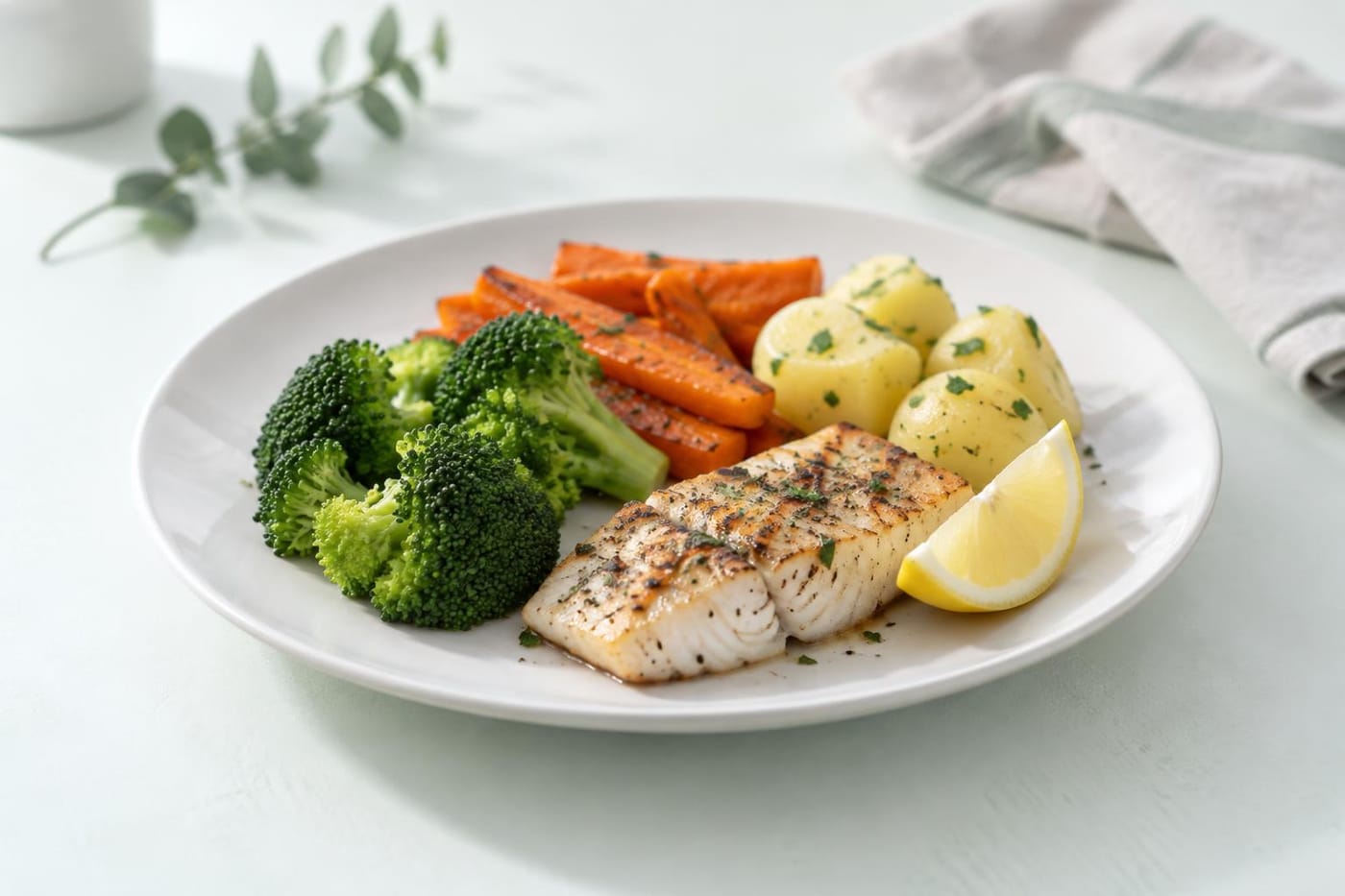
This is what a balanced plate looks like
- Salmon · 125 g +14.4
- Potato · 200 g −13.1
- Broccoli · 150 g −1.9
- Lemon juice · 10 ml −0.2
And this is a typical acid-heavy one
- Chicken breast · 150 g +19.8
- White rice · 180 g +3.2
- Gravy · 50 ml +0.2
- Parmesan cheese · 15 g +4.4
What the science says, and what it doesn’t
Supported by evidence: A high acid load increases acid excretion in the urine. In people who already have weakened kidney function, it is a risk factor for the condition getting worse. It promotes kidney stones and is a small factor in bone density in older age. People who eat a lot of vegetables and fruit have a lower acid load and better health markers, though for many reasons at once.
Not supported by evidence: that acid load causes cancer, allergies, cellulite or hair loss; that the body gets “clogged with toxins”; that alkaline powders or alkaline baths prevent disease; that diet lowers your blood pH (it doesn’t, your lungs and kidneys take care of that).
The honest summary: an alkaline diet is another way of saying “lots of vegetables, fruit and potatoes, animal foods in moderation.” Nobody disputes that this is healthy. The acid-base theory is one of several explanations for why, and the PRAL value is a practical tool for measuring it. You don’t need to believe anything more than that.
💡 Why measuring helps
Most people overestimate how many vegetables they eat and underestimate the cheese. Keeping a log for one week, whether on paper or in the app, corrects both faster than any guide.
The five levers that really count
- Cheese as a seasoning, not a topping. 10 g of Parmesan over vegetables: +3. Three slices of Gouda in a roll: +16.
- Potatoes instead of pasta, rice or bread as your default side. The single biggest lever, because you eat it every day.
- Vegetables are the main event, meat is the side. 100 g of meat, 300 g of vegetables.
- Legumes as your protein on meat-free days. Lentils at +3.1 instead of cheese at +17.5.
- Fruit instead of snack bars. A banana at −7.6 instead of a cereal bar at +1.2, per piece.
What you don’t have to do: cut out coffee, avoid sugar because of acid, ban bread, buy powders or use test strips.
Frequently asked questions
Is an alkaline diet the same as alkaline fasting? No. Alkaline fasting is a short-term regimen: one to two weeks of eating only alkaline foods. An alkaline diet is a long-term emphasis in which acid-forming foods are still allowed. If you eat only alkaline foods for the long term, you’ll run into a protein problem.
Can I follow an alkaline diet and still exercise? Yes, and athletes benefit in particular: lots of protein means a high acid load, and potassium from vegetables and potatoes offsets it. Only the idea of cutting out protein is wrong.
What about children and pregnant women? The same applies to both: eat a balanced diet, not a one-sided one. More vegetables and fruit never hurt, but cutting out protein and dairy does. Alkaline powders have no place here.
How do I find out how alkaline my diet is? Log everything for one week and look at your PRAL totals. You can do that by hand with the alkaline food list and the calculator, or automatically with the app.
Eat alkaline without doing the math.
Basentracker shows you where your day stands after every meal. Over 950 foods, photo scan, recipes, history. Free.
Free for Android · iPhone coming soon
Conclusion
An alkaline diet is not a belief system or a strict diet plan. It’s a matter of emphasis: vegetables, fruit, potatoes and herbs make up the majority, while cheese, meat, eggs and grains make up the minority. The PRAL value makes this measurable, and the surprises (coffee is alkaline, sugar is neutral, cheese is the most acid-forming) show why measuring beats guessing.